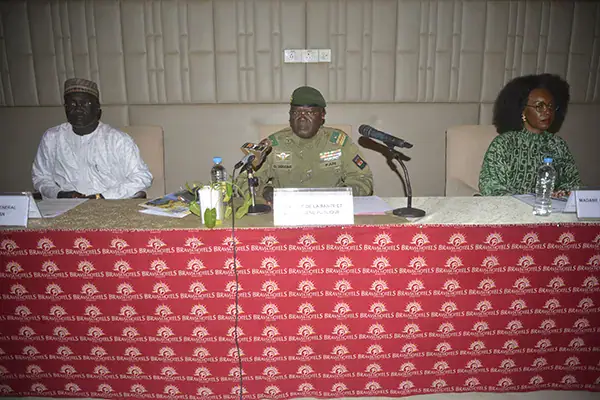
The Nigerien government has taken a significant step towards refounding the governance of humanitarian and social action with the installation of a national technical committee on localization and accountability towards affected persons. The committee, composed of experts from various institutions, aims to listen to communities, address their concerns, and strengthen the role of national and local actors in the design, management, and implementation of humanitarian interventions.
The committee was installed by the Minister of Health and Public Hygiene, Colonel-major Garba Hakimi, who is also serving as the interim Minister of Population, Social Action, and Solidarity. According to him, the establishment of this committee marks a significant milestone in the collective effort to reposition humanitarian and social action in the country, placing it firmly at the service of the nation's fundamental interests and populations.
The Minister emphasized that the committee's creation reflects a strong conviction that Niger must be fully in charge of its choices, priorities, and intervention mechanisms in the humanitarian field. He also highlighted the importance of this initiative, which will enable the implementation of agile development actions anchored in realities that respect human dignity, prioritizing populations so that all programs are developed with all layers through equipped national organizations.
The committee's primary mission is to coordinate strategies, federate all initiatives related to localization and accountability towards affected persons, mobilize necessary resources to strengthen local actors, and ensure that each humanitarian project integrates reliable complaint and feedback mechanisms. The Minister called on partners and actors to accelerate the transfer of competencies and direct financing of local structures, embodying transparency and rigor.
The Representative of the United Nations High Commissioner for Refugees (UNHCR), Ursula Dzietham, welcomed the creation of the committee, describing it as an important step towards humanitarian action anchored in national capacities, driven by local actors, and accountable to affected populations. She emphasized that communities must be not only beneficiaries of assistance but also actors in decisions and solutions that concern them.
Dzietham stressed the importance of investing in more effective, inclusive, and sustainable humanitarian action, where communities are not left behind in decision-making processes. She reaffirmed the UNHCR's availability to accompany this process, alongside other UN agencies and partners, by contributing its expertise, tools, and lessons learned from its partnerships with national and community organizations.
The National Working Group's focal point, Salissou Yacouba, explained that the group is a dynamic, inclusive, and parity-based coordination platform that brings together state technical services, national and local non-governmental organizations, Nigerien civil society, international humanitarian partners, and UN agencies. The committee's establishment is expected to enhance the localization of humanitarian action and promote accountability towards affected populations in Niger.
Key points
- The Nigerien government has established a national technical committee to anchor humanitarian action in national capacities, including affected populations.
- The committee aims to listen to communities, address their concerns, and strengthen the role of national and local actors in humanitarian interventions.
- The establishment of the committee reflects a strong conviction that Niger must be fully in charge of its choices, priorities, and intervention mechanisms in the humanitarian field.