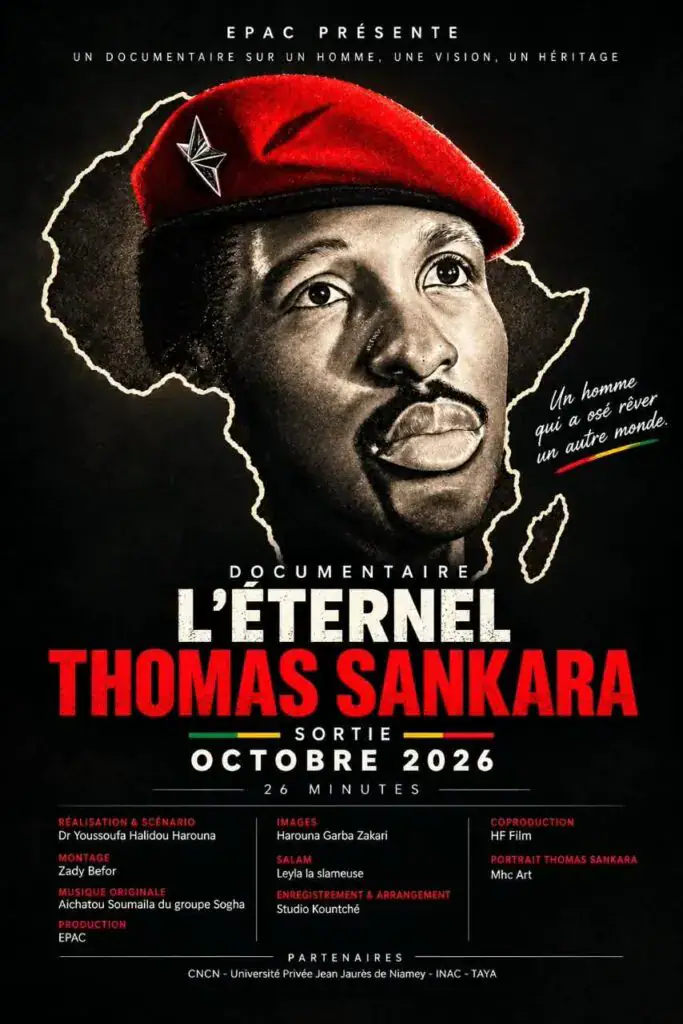
A documentary film titled "L'Éternel Thomas Sankara" had its premiere screening in Niamey on November 24, 2026, at the Institut National des Arts et de la Culture. The 26-minute short film was directed by Youssoufa Halidou Harouna and explores the lasting impact of Thomas Sankara, a Burkinabè revolutionary and statesman. The film features interviews with various individuals, including civil society actors, teachers, filmmakers, and young people in Niger.
The documentary examines Sankara's ideological and political legacy through the perspectives of several notable individuals, including Bana Ibrahim, a member of the AES Parliament, and Dr. Iro Tanimoun, an educator at the Université Abdou Moumouni. Other contributors include Harouna Niandou, a former minister and current presidential advisor, as well as filmmakers and scouts. These interviews are interwoven with footage of Thomas Sankara and a narrative that highlights his influence on the Nigerien people.
The documentary's narrative is complemented by the appearance of Leyla, a young Nigerien slam poet, and Aichatou Soumaila, a talented musician from the group Sogha. The film also features archival footage from the Radiodiffusion-Télévision du Burkina, illustrating Sankara's fight for a developed Africa. This narrative construction allows viewers to grasp the film's central theme while contextualizing the ideological and political stakes.
Following the screening, a debate ensued, with participants questioning the parallels between Thomas Sankara's trajectory and the current sociopolitical engagement of the Nigerien people. The discussion highlighted the significance of Sankara's legacy in the context of Niger's quest for sovereignty and refoundation. To better understand the scope of this legacy, it is essential to briefly revisit Sankara's background and his revolutionary ideals.
Thomas Sankara, born on December 21, 1949, in Yako, was a Burkinabè military officer, revolutionary, and statesman. He rose to power in 1983 and led the Conseil national de la révolution, implementing policies focused on democratic revolution, pan-Africanism, and anti-imperialism. Sankara's presidency was marked by efforts to promote self-sufficiency, women's emancipation, education, and environmental protection. His ideas continue to inspire people in Africa and worldwide.
The documentary's director, Youssoufa Halidou Harouna, aims to contribute to Niger's reconstruction dynamic through this film. The screening was followed by suggestions from participants, including the development of the documentary into a feature film and its broadcast on national television. Some attendees also proposed integrating Sankara's history and ideas into Niger's education system to transmit his convictions to future generations.
The documentary "L'Éternel Thomas Sankara" serves as a source of inspiration for the Nigerien population, echoing Sankara's ideals of national sovereignty, moral integrity, pan-Africanism, and economic self-sufficiency. As one famous quote attributed to Sankara states, "On peut tuer un homme, mais on ne peut pas tuer ses idées" ("One can kill a man, but one cannot kill his ideas").
Key points
- The documentary "L'Éternel Thomas Sankara" explores the lasting impact of Thomas Sankara's legacy on the Nigerien people.