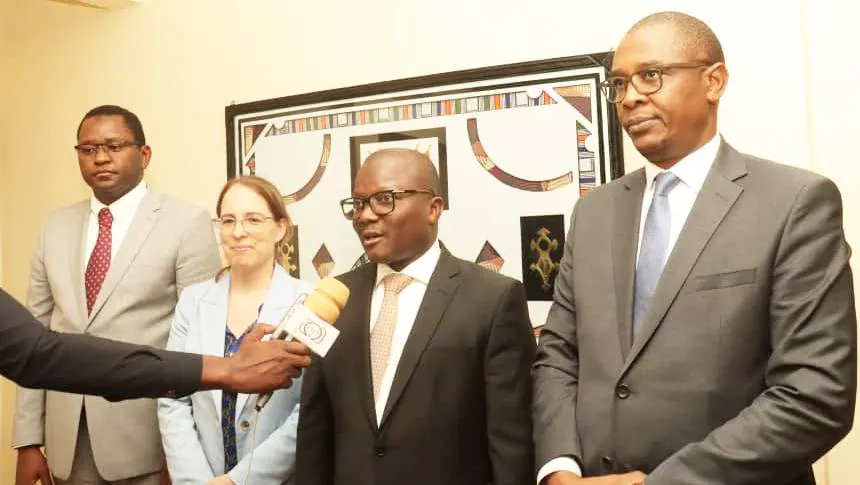
The Nigerien government and the International Monetary Fund (IMF) have reached a technical agreement on a new 38-month program worth approximately $203 million. This agreement was made during a mission led by Julia Bersch, IMF's mission chief for Niger, which took place in Niamey from September 28 to October 8, 2026. The program is subject to approval by the IMF's Executive Board.
The IMF has confirmed its forecast of 7% economic growth for Niger in 2026, driven primarily by the agricultural and extractive sectors. The country's economy is expected to grow at an annual rate of 6.1% in the medium term. Inflation is projected to average -2.5% in 2026 and 2.2% in 2027. These projections indicate a generally favorable evolution of prices, although transportation costs and certain imported products continue to weigh on vulnerable households.
The new program, worth 150.02 million special drawing rights (SDRs), or approximately $203 million, is under the Extended Credit Facility (ECF). The completion of the last review of the current program and the approval of the new arrangement could lead to a disbursement of around $36 million, which would help meet Niger's external financing needs and support the implementation of economic reforms.
The IMF has recognized Niger's progress in implementing its economic program, which has contributed to preserving macroeconomic stability and improving budgetary and external balances. Despite an environment marked by significant economic shocks, the results obtained have been judged solid. The budget deficit is expected to reach 3.4% of GDP in 2026, mainly due to reconstruction spending following natural disasters and measures to support vulnerable populations.
The IMF highlights the contribution of oil revenues to the improvement of external and budgetary accounts, as well as the continuation of efforts to clear domestic and external payment arrears. Nigerien Finance Minister Maman Laouali Abdou Rafa noted that these results reflect the effects of reforms implemented under the Refoundation of the Republic Program. IMF Mission Chief Julia Bersch praised the progress made in structural reforms and reaffirmed the institution's willingness to support the Nigerien government's efforts.
The new program is expected to extend macroeconomic stabilization efforts while supporting Niger's national development strategy for 2025-2029. Priorities include strengthening public revenue mobilization, preserving debt sustainability, improving public finance management, and consolidating financial stability. Particular attention will be paid to developing the private sector, especially by strengthening the financing capacities of small and medium-sized enterprises.
The agreement between Niger and the IMF constitutes an important step in their economic and financial relations. The next step will be the examination of the agreements by the IMF's Executive Board, expected in December 2026. The Board's decision will determine the conditions for the continuation of IMF financial support for Niger's economic program.
Key points
- The IMF projects Niger's economy to grow by 7% in 2026.
- A new $203 million program has been agreed upon under the Extended Credit Facility.
- The agreement is subject to approval by the IMF's Executive Board.