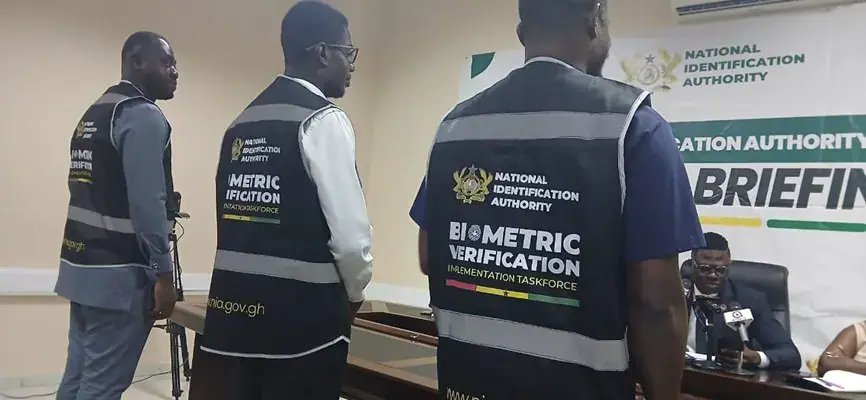
The National Identification Authority (NIA) of Ghana has started enforcing the National Identity Register (Amendment) Regulations, 2026 (L.I. 2523). This move aims to enhance identity verification processes and prevent identity fraud. Institutions that fail to comply with the new regulations risk facing fines of up to 2,000 penalty units. The NIA will deploy a Biometric Verification Implementation Task Force to inspect institutions and ensure compliance.
The enforcement of L.I. 2523 follows a three-month grace period granted to businesses and public institutions. During this period, the NIA conducted public education and stakeholder engagement activities to prepare institutions for the new regulations. The Authority's Corporate Affairs representative, William Ampomah Emmanuel Darlas, announced the commencement of enforcement at a press briefing in Accra on November 2, 2026.
Under the new regulations, institutions are required to use the NIA's approved biometric verification platform for identity verification. This platform relies on biometric data, including fingerprints, iris details, and facial features, stored in the Ghana Card's chip. Institutions are prohibited from photocopying, scanning, or keeping copies of the Ghana Card for verification purposes. Simply inspecting or comparing the Ghana Card's photograph with the cardholder is no longer a valid verification method.
The Ghana Card remains the country's official national identity document, and citizens are not required to register for a new card or recapture their biometrics. The new system aims to reduce identity fraud, impersonation, and other crimes by ensuring that the person presenting the Ghana Card is the actual owner. The NIA's biometric verification process uses information already captured during Ghana Card registration.
Institutions seeking access to the National Identity Register must deal directly with the NIA and complete its official onboarding process. This process requires institutions to prove they are legally registered companies in Ghana, obtain certification from the Data Protection Commission, and work with the NIA's technical team to establish a connection to its platform. The NIA warned institutions against using third-party companies or individuals to access its identity verification platform.
The NIA also cautioned institutions already connected to the platform against subletting their access to other businesses. Reports have been received of some institutions providing their verification services to other businesses without the NIA's approval. The Authority warned that those involved would face legal action. Institutions found guilty of non-compliance could face fines ranging from 500 to 2,000 penalty units, depending on the nature of the offence.
The NIA clarified that the new regulations do not prohibit all institutions from physically using the Ghana Card during transactions. Telecommunications companies can still use the match-on-card method, which requires customers to present their physical Ghana Cards for fingerprint matching against the biometric information stored on the card's chip. The Authority urged institutions to review their existing identity verification arrangements and regularise any non-compliant arrangements.
Key points
- Institutions that fail to comply with the new regulations risk facing fines of up to 2,000 penalty units.
- The NIA's biometric verification process uses information already captured during Ghana Card registration.
- Institutions must deal directly with the NIA and complete its official onboarding process to access the National Identity Register.