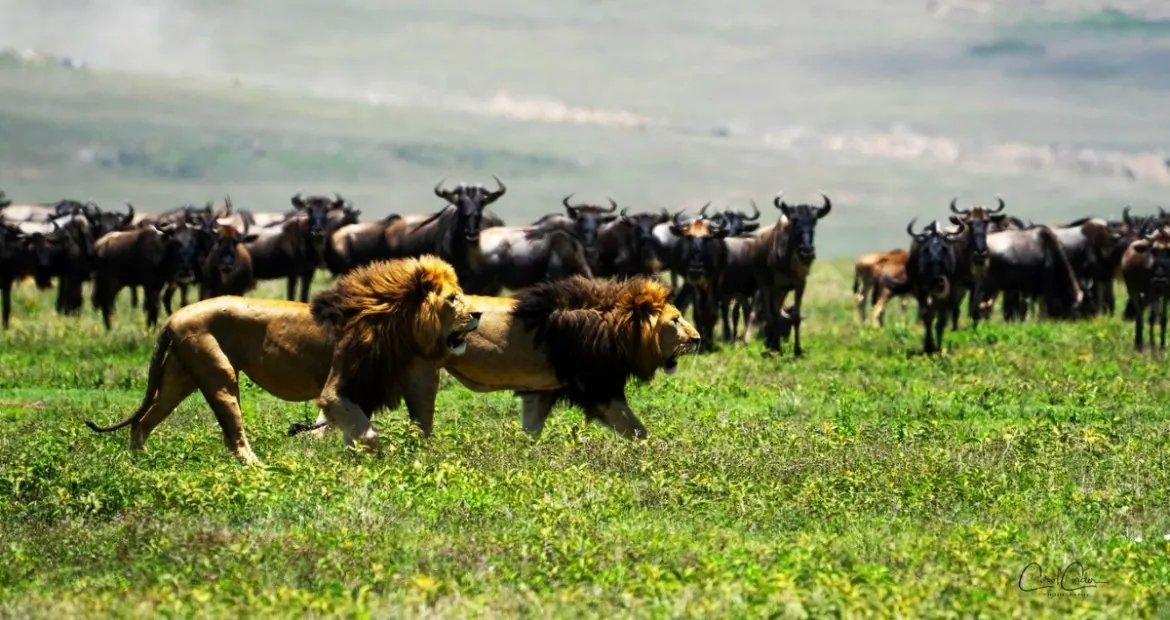
The Ngorongoro Conservation Area in Tanzania, a 67-year-old protected zone, is home to a unique population of lions that have been extensively studied. In 2019, the area celebrated its 60th anniversary as a protected zone, alongside the adjacent Serengeti National Park. Researchers have found that the lions residing in the Ngorongoro Crater, a 2,000-foot-deep caldera, are likely descendants of just 15 lions that either survived a plague or invaded the area shortly thereafter.
The first comprehensive study of the Ngorongoro Crater lions was conducted in 1979 by Craig Packer and his wife Anne Pusey. They began reconstructing the family tree of at least five generations of every lion that lived in the crater, using a monumental task of assembling and organizing lion photographs from around the world. The Packers' method involved using lion ID cards with pictures of individuals at various ages, noting field marks such as whisker spots and ear notches to pinpoint lions.
The study revealed that the entire crater population descended from 15 animals, with only eight individuals surviving a plague that devastated the population in 1962. The plague, caused by biting flies, reduced the population of at least 70 lions to about ten. The crater's isolation, surrounded by steep cliff walls, has limited the entry of new lions, leading to close inbreeding since 1969, about five lion generations.
Genetic studies were conducted in 1984 by Steve O'Brien at the National Cancer Institute and his colleagues from Washington's National Zoo. They assessed the genetics and reproductive physiology of the crater lions, comparing them with the nearby Serengeti lions, which have shown little close inbreeding. The studies aimed to understand the impact of inbreeding on the crater lion population.
Historical records show that the crater lions have faced threats before. In the early 1920s, hunting parties killed several adult lions, severely reducing the breeding population. The Serengeti and Ngorongoro were declared wildlife sanctuaries in the late 1920s to protect the lions from further hunting. Ngorongoro Crater became a world heritage site in 1979, recognizing its special significance as a microcosm of African savanna.
The inbreeding factor has raised concerns about the long-term survival of the crater lion population. With increased human habitation around Africa's national parks, many species have become isolated in small populations, making them vulnerable to environmental catastrophe. The crater lions' situation may represent the future for many other large vertebrates, highlighting the need for conservation efforts to protect not just the lions but also their habitat.
Conservation efforts are necessary to prevent the decline of small populations like the Ngorongoro Crater lions. According to Packer, perpetuating these populations will require more than just protecting them from hunters and poachers. The entry of outside lions with new genes is crucial to prevent further inbreeding and ensure the long-term survival of the population.
Key points
- The lions in Ngorongoro Crater are likely descendants of just 15 cats.
- The crater lion population has been subject to close inbreeding since 1969.
- Conservation efforts are necessary to prevent the decline of small populations like the Ngorongoro Crater lions.