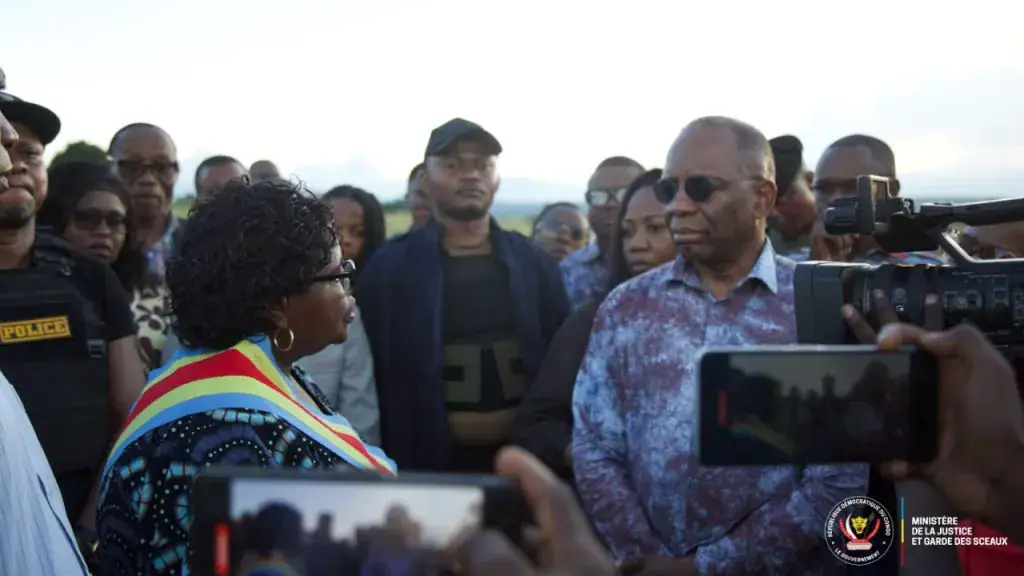
Democratic Republic of Congo's Justice Minister, Guillaume Ngefa, has taken a firm stance against the illegal occupation of the Kikwit airport, denouncing the grabbing of state property as a recurrent problem across the country. During a recent visit to Kikwit, Ngefa emphasized that the law must be rigorously enforced against those responsible for spoliating state assets. He noted that public domain properties are inalienable and cannot be privately appropriated without following legal procedures.
The Kikwit airport has been significantly impacted by the land grabbing, with the surrounding area now densely populated with houses, reducing the airport's safety margins and posing risks to air navigation. According to Kikwit Mayor, the situation has been deteriorating over a decade, with the airport's runway shrinking due to encroaching constructions. The mayor questioned the origin of titles and documents that legitimized these occupations, pointing to a self-proclaimed customary chief who allegedly sold plots within the airport's perimeter.
Ngefa strongly condemned these practices, stressing that no customary authority can justify the sale or illegal appropriation of state public property. He reminded that prosecutors have the power to take up cases of suspected infractions to establish responsibilities and initiate judicial proceedings. The minister cited the example of Muanda, in Kongo Central Province, where legal actions were taken following the destruction of mangroves and illegal constructions in protected areas.
The Justice Minister announced the creation of an inter-ministerial commission, under his leadership, tasked with identifying cases of land grabbing across the country. This initiative aims to enable the state to reclaim its rights and recover illegally occupied properties. Ngefa emphasized that the fight against spoliation involves not only recovering public assets but also establishing responsibilities, including those of potential accomplices within the administration.
Ngefa also underscored the responsibility of land administration and cadastral services, particularly conservators of real estate titles, in controlling the regularity of land transactions and issuing property documents. He recalled a fundamental principle: state patrimony cannot be surrendered to private interests or removed from legal protection. The minister's visit to Kikwit highlights the government's determination to address the issue of land grabbing and protect public property.
Local authorities and residents have welcomed Ngefa's firm stance on the matter, calling for an end to the illegal occupations and the restoration of the airport's original boundaries. The situation in Kikwit is not unique, with similar cases reported in other parts of the country. The government's efforts to tackle land grabbing are seen as a crucial step towards protecting public assets and maintaining the rule of law.
As the government moves forward with its plans to recover illegally occupied land, residents and local leaders are hopeful that the situation will improve. The inter-ministerial commission's work will be closely watched, as it aims to address the root causes of land grabbing and prevent future occurrences. With Ngefa's commitment to enforcing the law, there is optimism that the Kikwit airport and other public properties will be protected from further encroachment.
Key points
- The DRC government has launched an initiative to recover illegally occupied public properties, starting with the Kikwit airport.