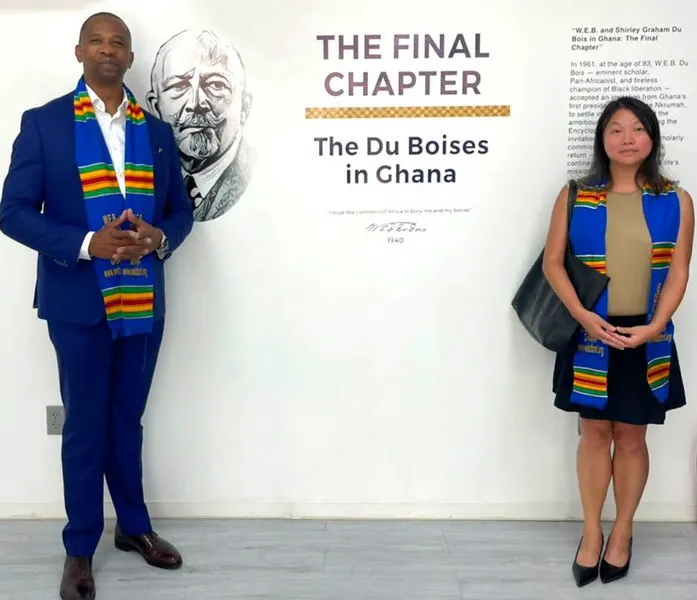
In 1961, at the age of 93, W.E.B. Du Bois left the United States for Ghana, where he worked on the Encyclopedia Africana, a project to document African history and achievements. Du Bois became a Ghanaian citizen and worked on the project until his death in Accra on August 27, 1963. More than six decades later, New York State Secretary Walter Mosley visited the W.E.B. Du Bois Memorial Centre for Pan-African Culture in Accra, retracing Du Bois's final steps.
Mosley, who chairs the New York State Commission on African American History, toured the W.E.B. Du Bois Centre, which is currently under renovation. Despite the renovation, Mosley was able to view a photograph exhibit tracing Du Bois's path from scholar and editor in the United States to his final years in Accra. He also visited the document preservation lab where Du Bois's papers, books, and records are kept for future researchers.
During his visit, Mosley laid a wreath at Du Bois's tomb inside the mausoleum, where the scholar is buried alongside his wife, Shirley Graham Du Bois. The visit was arranged by Maurice Cheetham, founder of Diaspora Bridge Consulting, which links diaspora leaders with Ghanaian government, traditional, business, and cultural institutions. Mosley's trip included engagements with civic and community leaders in Accra.
The W.E.B. Du Bois Centre has long served as a touchstone for Ghana's Pan-African heritage tourism. The Centre, opened by President Jerry John Rawlings on June 22, 1985, has been a key destination for African-American and diaspora visitors to Ghana. Mosley's visit followed his meeting with Japhet Aryiku, Executive Director of the W.E.B. Du Bois Museum Foundation, which works with the Government of Ghana to expand the memorial into a fuller museum complex.
Discussions between Mosley and the Foundation reportedly centred on connecting the project with New York philanthropic foundations focused on history and education, as well as business leaders and diaspora investors with Ghana ties. The Foundation's partnership agreement with the Ghanaian government was signed in New York City in 2021. Du Bois built much of his career in New York, where he co-founded the NAACP in 1909 and edited its magazine, The Crisis, for more than two decades.
The next phase of the museum expansion depends on a wider fundraising campaign, with board members having already contributed to restoring Du Bois's bungalow. The Centre remains open to visitors on a limited basis, typically Monday to Friday from 9 a.m. to 4 p.m. and Saturday from 10 a.m. to 3 p.m. Some areas are closed while construction continues. No firm date for completing the Centre's renovation has been given.
Mosley's visit to the W.E.B. Du Bois Centre highlights the ongoing efforts to preserve the scholar's legacy and promote Pan-African heritage tourism in Ghana. The Centre's renovation and expansion are expected to further enhance its role as a cultural and educational destination. Key stakeholders, including Mosley, continue to explore opportunities for collaboration and support for the project.
Key points
- New York State Secretary Walter Mosley visited the W.E.B. Du Bois Centre in Accra to retrace the scholar's final steps and explore opportunities for collaboration.
- The W.E.B. Du Bois Centre is undergoing renovation and expansion, with a wider fundraising campaign planned to support the project.
- The Centre serves as a touchstone for Ghana's Pan-African heritage tourism, attracting African-American and diaspora visitors to the country.