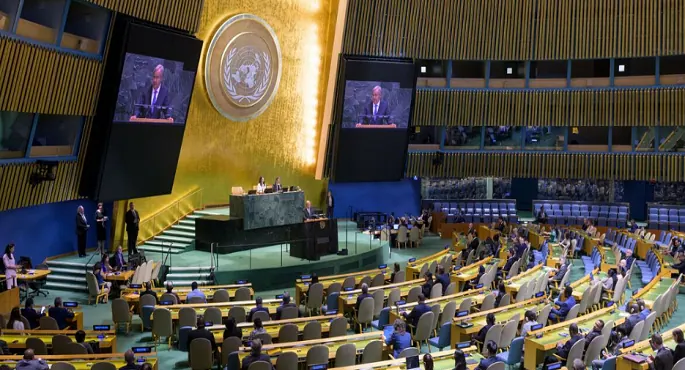
New York, September 21, 2026 - The city of New York is set to become a hub of global diplomacy as world leaders and high-ranking officials from around the world converge on the United Nations headquarters for the annual high-level meetings of the General Assembly. This year's session, which began earlier this month, is being chaired by Khalil Rahman of Bangladesh under the theme "Restoring Trust, Managing Transformation: A United Nations for All." The meetings will focus on pressing global issues such as conflicts, climate change, pandemic preparedness, and achieving sustainable development goals.
The high-level meetings, which kicked off on September 22, will feature speeches from leaders of the UN's 193 member states. These speeches are expected to highlight national priorities and concerns, with a focus on conflicts, economic challenges, humanitarian crises, climate change, and emerging technologies. In addition to the speeches, hundreds of bilateral and multilateral meetings will take place behind closed doors, providing leaders with a rare opportunity to engage with allies, partners, and rivals.
On September 18, leaders attended an annual event titled "SDG Moment," which aims to assess progress toward achieving the 17 Sustainable Development Goals (SDGs) adopted by countries in 2015. With less than five years remaining to achieve these goals by 2030, the focus will be on evaluating progress and identifying practical solutions that can be scaled up and applied elsewhere. The SDGs address a range of challenges, including poverty, hunger, education, and access to clean water and energy.
On September 23, UN Secretary-General António Guterres will convene a high-level meeting on climate action and a just transition to renewable energy. As global temperatures continue to rise, discussions will center on accelerating the transition to renewable energy, expanding climate financing for developing countries, and supporting communities already affected by climate change. The following day, leaders will address the issue of rising sea levels, which poses a significant threat to small island developing states and low-lying coastal communities.
On September 25, leaders will review lessons learned from the COVID-19 pandemic, which highlighted significant disparities in access to vaccines, medicines, and other essential resources. The meeting on pandemic prevention, preparedness, and response will focus on strengthening health systems, improving preparedness, and ensuring a more equitable international response to future health crises. Other key issues on the agenda include discussions on racism and the 40th anniversary of the Declaration on the Right to Development.
The high-level meetings will also commemorate the 25th anniversary of the Durban Declaration and Programme of Action, a key international framework for combating racism and xenophobia. Furthermore, a high-level meeting on September 29 will focus on the International Day for the Total Elimination of Nuclear Weapons, highlighting the need for nuclear disarmament. As the current Secretary-General's term comes to an end, these meetings will take place against the backdrop of increasing global challenges and pressures on multilateralism.
As world leaders gather for the high-level meetings, they will be reminded of the importance of collective action in addressing global challenges. The UN Secretary-General has emphasized that the organization's purpose is to promote unity and cooperation among nations, and that together, countries can achieve more than they can alone. The meetings will provide an opportunity for leaders to demonstrate their commitment to this principle and to work toward finding solutions to the complex problems facing the world.
Key points
- World leaders are gathering at UN headquarters for high-level meetings to address pressing global issues.
- The meetings will focus on conflicts, climate change, pandemic preparedness, and achieving sustainable development goals.
- The high-level meetings will feature speeches from leaders of the UN's 193 member states and hundreds of bilateral and multilateral meetings.