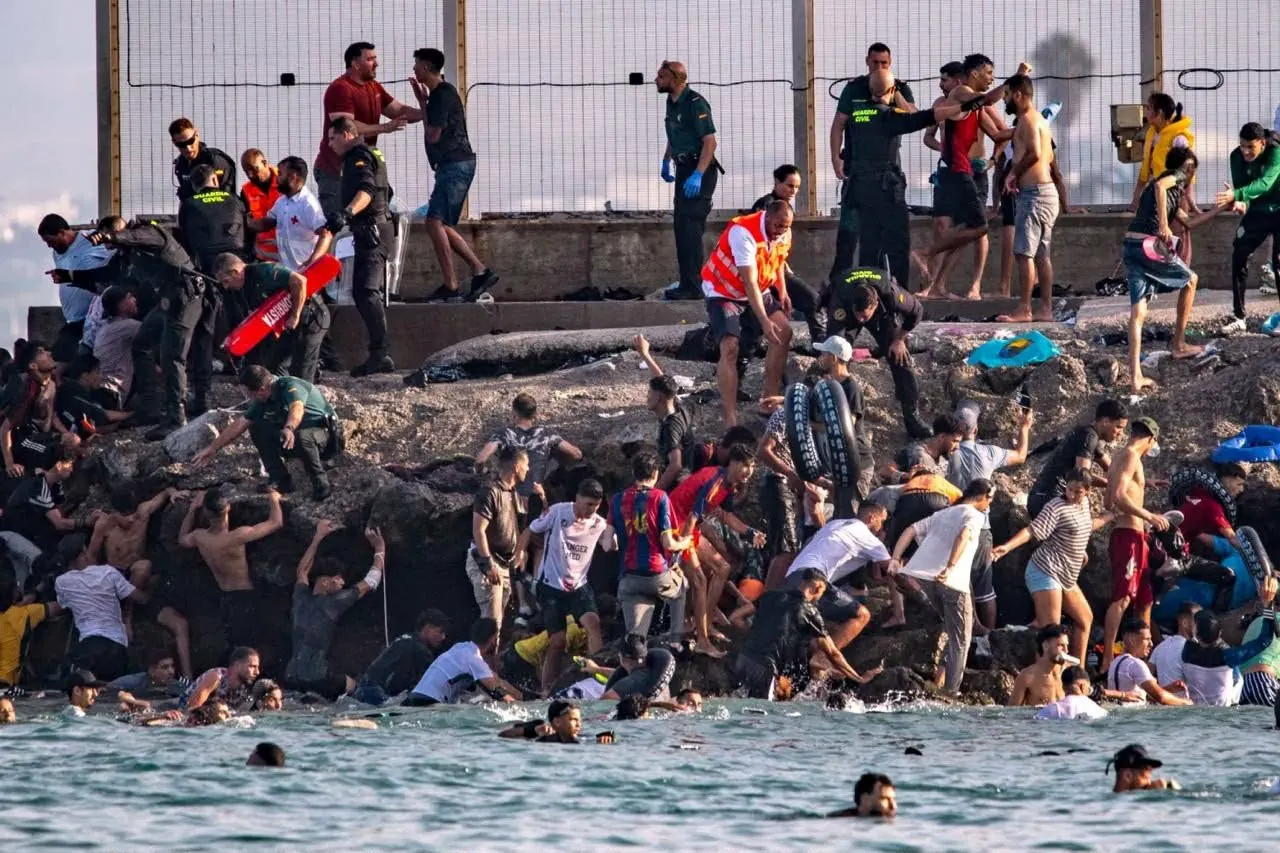
A new report by Spanish newspaper La Razón has reignited controversy surrounding the mass entry of people into Ceuta, a Spanish enclave in Morocco, on July 30. The report alleges that certain factions within Morocco's ruling elite, referred to as the "Makhzen," may have been involved in organizing and directing the event. According to the report, this alleged involvement included issuing orders to Moroccan forces deployed along the border.
The report, which cites sources described as intelligence operatives from Morocco and Spain, claims that the Moroccan authorities' handling of the large groups of people attempting to enter Ceuta suggests that there were prior operational instructions in place. This, the report argues, was not simply a case of losing control of the situation. The report's author, journalist and security expert José María Gil Garrido, based his claims on data from Spanish intelligence and military sources, as well as intercepted communications.
This new narrative marks a shift from earlier claims that suggested Algerian-linked accounts were behind the digital incitement to enter Ceuta. Instead, the report implicates internal Moroccan actors. However, the allegations made by La Razón remain to be verified with independent evidence. The report's reliance on attributed intelligence sources and expert analysis raises questions about the availability of concrete proof.
Previously declassified Spanish documents revealed that, on July 30, Spanish authorities were aware of widespread calls on social media to enter Ceuta. Subsequent analysis by Spanish agencies explored various hypotheses regarding the Moroccan authorities' handling of the situation, including the possibility of "passivity" or even collusion. These hypotheses, however, were not universally accepted.
The incident has strained relations between Morocco and Spain, with both countries seeking a diplomatic resolution. Spanish officials, including Foreign Minister José Manuel Albares, have called for calm and emphasized the need for dialogue. The incident has also raised questions about the management of migration flows and border security in the region.
The Spanish government has been working to address the situation through diplomatic channels, with a focus on finding a mutually beneficial solution. This approach aims to prevent similar incidents in the future and strengthen cooperation between Morocco and Spain on migration and security issues.
The controversy surrounding the mass entry into Ceuta continues to unfold, with multiple investigations and reports shedding light on the complex circumstances surrounding the event. As the situation develops, both Morocco and Spain are expected to continue working towards a resolution that addresses the root causes of the incident and promotes greater cooperation between the two nations.
Key points
- The report alleges that certain factions within Morocco's ruling elite may have played a role in organizing the mass entry of people into Ceuta.
- The incident has strained relations between Morocco and Spain, with both countries seeking a diplomatic resolution.
- The controversy surrounding the mass entry into Ceuta continues to unfold, with multiple investigations and reports shedding light on the complex circumstances surrounding the event.