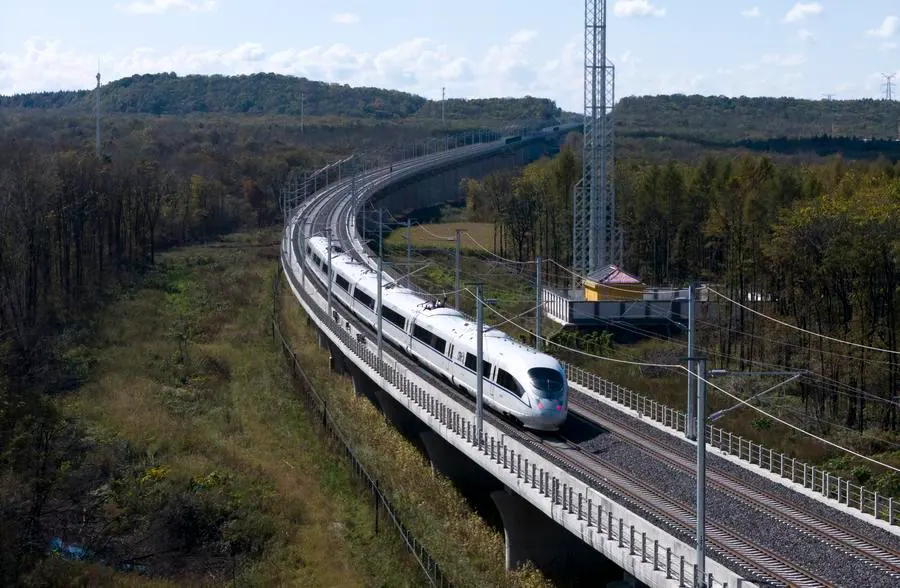
China has recently opened several new high-speed rail lines, including the 318-kilometer line connecting Harbin with Yichun in Heilongjiang Province. The line, which officially entered service on September 28, has cut railway travel time between the two cities from about seven hours to roughly two hours. This new line is part of China's efforts to direct more transport infrastructure investment toward border areas, forest regions, and less-developed regions.
The new high-speed rail lines are expected to boost tourism and regional development in China. The Xi'an-Ankang high-speed railway, which also opened on September 28, has cut travel time between the two cities from three hours to as short as 45 minutes. Ankang, a city in the mountainous area of southern Shaanxi, is rich in ecological resources. The new line is expected to drive demand for multi-purpose and experience-oriented tourism products.
The expanding high-speed rail network is bringing cities and city clusters much closer together. According to Ma Botao, of the China Railway Economic Planning and Research Institute, commuting within metropolitan areas now takes about one hour, living and working across city clusters about two hours, and business travel between neighboring city clusters and provincial capitals around three hours. This is expected to boost the flow of talent, technology, and capital across regions.
The new lines are also expected to drive industrial cooperation and development along the routes. The Xiong'an-Shangqiu section, which fills a gap in Xiong'an New Area's southbound high-speed rail corridor, facilitates commuting and business exchanges for relocated enterprises and institutions. This is expected to support stronger industrial cooperation along the route.
Cities newly connected to the network will need to position themselves to seize the opportunities brought by the new lines. According to Ma, large cities should focus on research and development, finance, and headquarters economy, while small cities should leverage their local agriculture, ecology, tourism, and distinctive industrial strengths to undertake supporting manufacturing, agricultural product processing, and wellness and cultural tourism.
China's high-speed rail network is expected to continue growing, with a projected 70,000 km of high-speed rail by 2035. The network will connect major cities, city clusters, and key economic zones throughout the country. By the end of 2025, the country's total operating railway mileage had reached 165,000 km, including more than 50,000 km of high-speed rail.
The growth of the high-speed rail network is also expected to bring economic benefits. Fixed-asset investment in the railway sector totaled 511.8 billion yuan in the first eight months of the year, up 1.5 percent year on year. The railway sector is expected to continue to drive economic growth and development in China.
Key points
- China opens new high-speed rail lines, cutting travel time and boosting regional development
- The expanding high-speed rail network is bringing cities and city clusters much closer together
- China's high-speed rail network is expected to continue growing, with a projected 70,000 km of high-speed rail by 2035