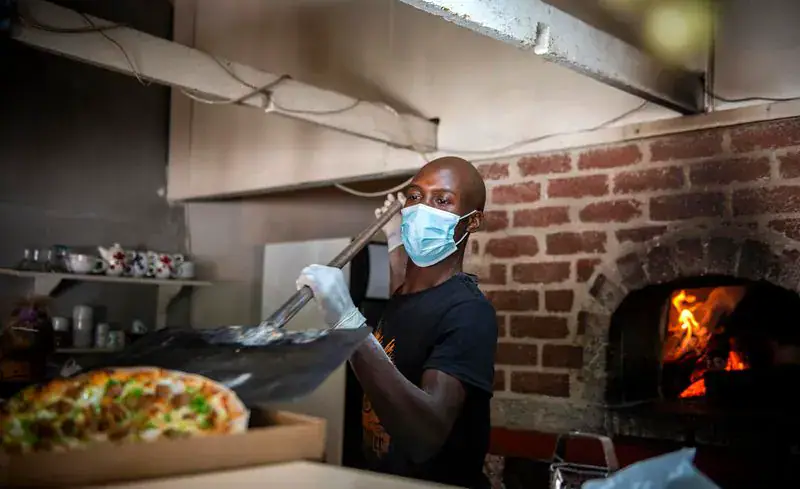
The franchising sector in South Africa, estimated to do R1-trillion in turnover annually, is seeing a shift towards new models that expand business ownership. About one out of every five rand earned in the sector comes from serving food, with many being pizza places. This accounts for roughly 3% of South Africa's GDP. The sector's growth has led to innovative approaches to franchising, making it more accessible to entrepreneurs.
Col'Cacchio, a 32-year-old pizza chain, has introduced the Col'Cacchio Go model, a small-format store with digital counter service. This adaptation reduces capital expenditure requirements from R6-million to R2.5-million per outlet, making it easier to buy into as a franchise owner. The company's group CEO, Etienne Pieterse, prefers to use the term "partners" instead of franchisees, emphasizing the partnership aspect of their business.
Col'Cacchio combines national quality standards for core commodities with localized autonomy for regional produce and wood sourcing. Store owners can source fresh produce and wood locally and maintain signature menu pages unique to their location. Pieterse views each store as a mom-and-pop store, with local owners putting in hard work. This approach allows for an authentic, community-focused dining experience.
Vladislav Priadko, founder of Coffee Bike World, advocates for a business model centered on independent equipment ownership. His company provides mobile coffee and chai catering services, with 36 mobile units distributed across 31 independent owners in Canada, the US, and Peru. Priadko's model eliminates recurring franchisor fees and mandatory supply constraints, giving owners control over their business.
Priadko's approach allows owners to build their own brand and benefit from local relationships and reputation. He believes that expanding internationally does not require uniform store execution, but rather operational knowledge that can travel across borders. This flexibility is crucial in meeting local consumer preferences and economic realities.
WAXIT, a local wax-only specialist brand, operates 49 branches under a traditional franchise model, with standard store setup costs at approximately R1.7-million. To address steep upfront capital requirements, founder Michelle Royston established an internal micro-franchise incubation pathway. This framework provides mentorship and secured funding support to long-serving team members who demonstrate operational excellence.
Royston's goal is to build a legacy, not an empire, by empowering people through sustainable ownership pathways. The micro-franchise incubation pathway has proven to be successful, demonstrating that with the right structure and accountability, internal candidates can become true operators. This approach has significant implications for expanding business ownership and creating opportunities for entrepreneurs in South Africa.
Key points
- New franchise models prioritize flexibility and local autonomy.
- Independent equipment ownership is a growing trend in franchising.
- Micro-franchise incubation pathways can create sustainable ownership opportunities.