Africa is renowned for its rich biodiversity, with up to 25% of the world's animal and plant species found on the continent. This diversity is driven by varied habitats and deep evolutionary roots, with many animal and plant groups originating in Africa. The continent boasts an array of fossil finds, including those of dinosaurs, which have been excavated for nearly two centuries. Zimbabwe is an important part of the African dinosaur puzzle, with dinosaur bones reported since 1916.
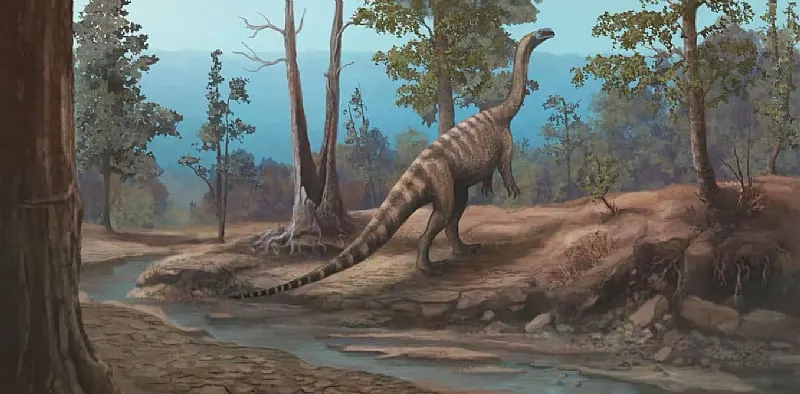
A new species of sauropodomorph dinosaur, Musango matusadonaensis, has been discovered in Zimbabwe. The incomplete skeleton was found in the bank of the Nyamasango River, and its anatomy reveals that it was bipedal, reached about 4.5 meters in length, and weighed 220kg. Growth marks in its bones indicate that it was a subadult when it died. Although the skull was not preserved, its close relatives were largely herbivorous.
The discovery of Musango and its relative Musankwa, described in 2024, reveals that Zimbabwean dinosaurs are unique and distinct from those found in South Africa. Despite their similar age and geographic proximity, the material collected so far has revealed animals that are distinct from those elsewhere. These Zimbabwean dinosaurs are not even the closest relatives of their South African neighbors.
The search for dinosaur fossils in Zimbabwe has a long history, with early finds overlooked by many scientists until the 1970s. Pioneering work by Zimbabwean palaeontologists Geoffrey Bond and Michael Raath led to the discovery of abundant material in the hinterlands of Bulawayo and the lower Zambezi Valley. However, palaeontological work in Zimbabwe stalled for a few decades, until a band of devoted fossil hunters, including Steve Edwards, found new sites on the shore of Lake Kariba.
An international team of researchers, led by Jonah Choiniere, was assembled to explore the new fossil sites further. The team used a mobile hotel and laboratory, a houseboat on Lake Kariba, to prospect the shoreline and collect material. Two expeditions, in 2017 and 2018, yielded a trove of material, collected from brick-red mudstones and sandstones that were laid down by ancient rivers around 210 million years ago.
The fossil-bearing rocks in Zimbabwe date back to the Late Triassic period, a time when the landscape was dry and dotted with stands of large conifer trees. Geological evidence and plant fossils show that the Triassic landscape of Kariba was characterized by green corridors of vegetation following permanent watercourses. The unique combination of fossils found in Zimbabwe, including lungfish and aquatic reptiles, suggests that the region's ecosystem was distinct from that of South Africa.
The discovery of Musango and other unique Zimbabwean dinosaurs is shedding new light on early dinosaur evolution in Africa. The findings suggest that environmental conditions, such as climate, may have played a role in shaping the diversity of dinosaurs in the region. Further research is planned to collect more fossils, information on the exact ages and environments of the dinosaur-bearing rocks, and to compare them with sites elsewhere.
Key points
- Zimbabwe's dinosaur fossils reveal a unique set of species distinct from those found in South Africa.
- The discovery of Musango and other Zimbabwean dinosaurs is shedding new light on early dinosaur evolution in Africa.
- Environmental conditions, such as climate, may have played a role in shaping the diversity of dinosaurs in Zimbabwe.