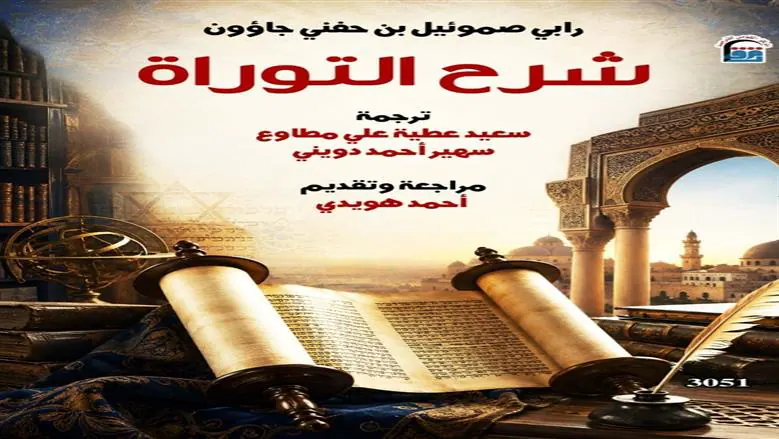
The National Center for Translation in Egypt, led by Dr. Muhammad Nsr Eddin El-Gbali, has recently published "Commentary on the Torah", a significant addition to the Arabic library. Written by Rabbi Samuel ben Hufni Gaun, also known as R. Sh. B. H., and translated by Saeed Attia Ali Matawe and Suhair Sayed Ahmed Dowini, the book offers valuable insights into medieval Jewish thought. The text, reviewed by Ahmed Mahmoud Atwa Howidi, represents an important source for understanding Torah interpretation in the Middle Ages.
The publication of "Commentary on the Torah" aligns with the National Center for Translation's mission to make intellectual and heritage works available to the public. By providing access to such texts, the center aims to promote cross-cultural understanding and facilitate dialogue between different civilizations. This book, in particular, sheds light on the intellectual exchange between Jewish and Islamic traditions during the medieval period.
As a key source for understanding Torah interpretation in the Middle Ages, "Commentary on the Torah" builds upon the rational approach of Rabbi Saadia Al-Fayoumi. The author's methodology relies on linguistic and semantic analysis, drawing on Muslim sciences and interpretations. This includes the use of rhetorical devices and the distinction between literal and figurative language.
The book engages with Torah texts in a detailed and explanatory style, often drawing comparisons with the Talmud. In some instances, it enters into discussions on jurisprudence and judicial matters, reflecting the influence of Islamic legal literature. This interaction between Jewish and Islamic intellectual traditions underscores the complex and dynamic nature of cultural exchange during this period.
One of the notable aspects of "Commentary on the Torah" is its emphasis on rational inquiry and its rejection of supernatural and superstitious beliefs. The author argues that miracles occur only through the agency of prophets, demonstrating a commitment to logical and evidence-based reasoning.
The publication of "Commentary on the Torah" holds significant value for researchers in various fields, including Old Testament studies, interfaith dialogue, and the history of the Arabic language during the medieval period. The book highlights the deep connections between Jewish and Islamic intellectual traditions, particularly in the areas of interpretation, language, and jurisprudence.
The translation of "Commentary on the Torah" serves as a bridge between cultures and time periods, facilitating the transmission of knowledge and ideas across linguistic and geographical boundaries. As a work of scholarship, it contributes to a deeper understanding of the complex and multifaceted nature of human knowledge and intellectual history.
Key points
- The National Center for Translation's publication of "Commentary on the Torah" promotes cross-cultural understanding and facilitates dialogue between different civilizations.
- The book offers valuable insights into medieval Jewish thought and Torah interpretation.
- The publication highlights the intellectual exchange between Jewish and Islamic traditions during the medieval period.