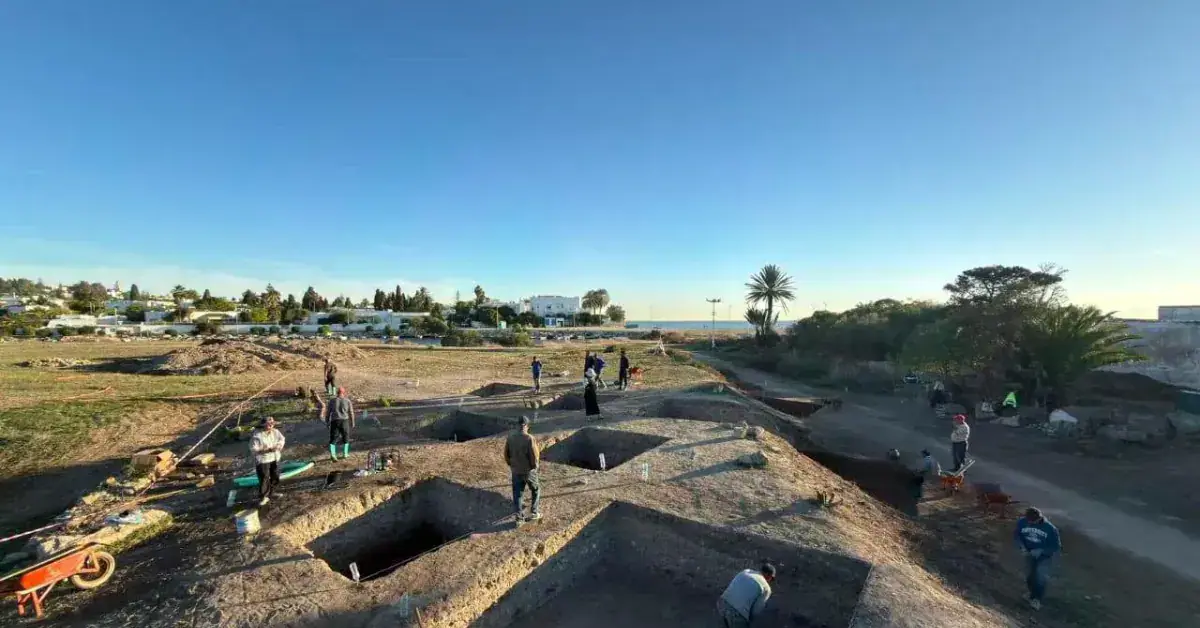
The ongoing excavations in Carthage's Punic ports, which began on October 19, have yielded significant archaeological findings. The excavations are a collaborative effort between the National Heritage Institute and the Chinese National Center for Archaeology. A defensive wall from the Roman era has been uncovered, which is believed to be the outer wall of the circular harbor.
The excavations have also revealed several large stone blocks that are thought to have been part of a wave-breaking structure. According to a statement released by the National Heritage Institute on November 26, these discoveries provide valuable insights into the development of the port facility in Carthage. The findings suggest that the site has been continuously occupied from the Punic period to the Byzantine era.
The archaeological artifacts discovered during the excavations include ancient jars, oil lamps, and bronze coins. These finds demonstrate the significance of the site and provide a glimpse into the lives of the people who lived and worked there. The National Heritage Institute has confirmed that the excavations and documentation are ongoing.
The goal of the ongoing excavations is to gain a deeper understanding of the relationship between the archaeological layers and the foundations of the buildings within the site. By analyzing the findings, researchers hope to reconstruct the evolution of the port facility in Carthage. The discoveries have generated significant interest among archaeologists and historians.
The collaboration between the National Heritage Institute and the Chinese National Center for Archaeology has facilitated the exchange of expertise and knowledge. The excavations have provided a unique opportunity for researchers to study the site and its significance in the context of Mediterranean history. The findings are expected to shed new light on the history of Carthage and its role in the ancient world.
The National Heritage Institute has emphasized the importance of preserving the site and its cultural heritage. The ongoing excavations are a testament to the commitment to protecting and promoting Tunisia's rich cultural legacy. The discoveries in Carthage's Punic ports are a significant addition to the country's archaeological heritage.
The excavations in Carthage's Punic ports are a significant development in the field of archaeology. The findings have the potential to rewrite the history of the region and provide new insights into the lives of the people who lived there. The collaboration between international partners has facilitated the discovery of new archaeological sites and the preservation of cultural heritage.
Key points
- The discovery of a Roman-era defensive wall and several artifacts in Carthage's Punic ports provides valuable insights into the site's history and significance.