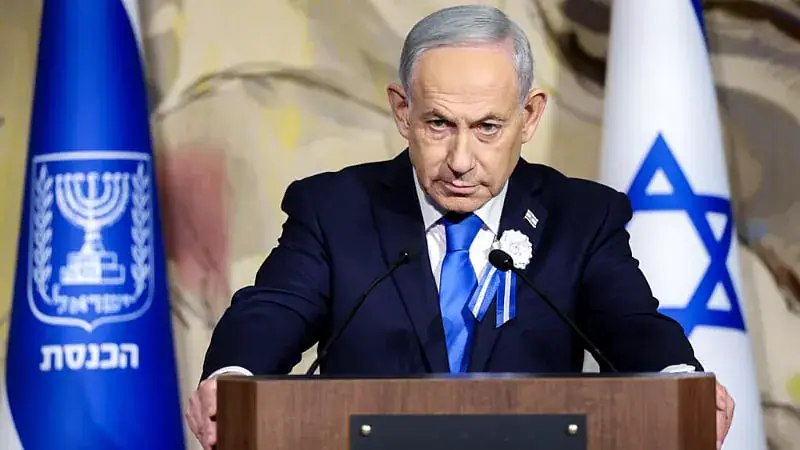
Israeli caretaker Prime Minister Benjamin Netanyahu has renewed his call for a national unity government with his opponent Gadi Eisenkot, who has rejected the appeal. In a video statement, Netanyahu said a unity government would guarantee Israel's security and eliminate the Iranian threat. He proposed a government made up of parties that recognise Israel as a state for the Jewish people, addressing security challenges, particularly Iran's nuclear threat.
Eisenkot, who was tapped to form a government, dismissed Netanyahu's appeal as a trick. He stated that Netanyahu knows he lost the election and is trying to sow division and stoke tensions. Eisenkot's bloc has 48 lawmakers, while Netanyahu's has 46, and they are negotiating with Arab and ultra-Orthodox parties that could abstain, allowing a minority government to be approved.
Netanyahu warned against Eisenkot's plan to form a minority government, describing it as weak and dangerous. He urged Eisenkot to meet without preconditions and reach agreements for Israel's security and future. However, Eisenkot reiterated his calls for a break with extremists, including supporters of far-right minister Itamar Ben Gvir, as a condition for participation in a government under his leadership.
A unity government with Netanyahu remains unlikely, especially after Eisenkot denounced his racist campaign against Arab parties. Eisenkot has indicated openness to forming a government with members of Netanyahu's Likud party and Religious Zionism, provided their commitment to unity is sincere. The election of the Knesset speaker is another point of contention, with the opposition putting forward Matan Kahana to replace Amir Ohana, a close Netanyahu ally.
Eisenkot stated that if Likud and its allies seek a sincere partnership, they must allow the democratic process to unfold normally and support Matan Kahana's appointment. Netanyahu's proposed unity government would exclude Arab parties, which gained a record number of seats in the election. Negotiations to form a government are expected to be difficult, with a 28-day deadline and a possible 14-day extension.
The Israeli parliament is set to be sworn in as Eisenkot prepares his government. The Knesset has 120 seats, and a government can be approved without an absolute majority if Arab and ultra-Orthodox parties abstain. Netanyahu's call for unity comes as Eisenkot is in the midst of negotiations to form a government.
The tension between Netanyahu and Eisenkot reflects the challenges of forming a new government in Israel. The outcome will have significant implications for Israel's security, particularly in regards to Iran's nuclear threat. The international community is watching closely as Israel navigates this critical period.
Key points
- Netanyahu proposes a national unity government to address security challenges, particularly Iran's nuclear threat.
- Eisenkot rejects Netanyahu's appeal, citing his racist campaign against Arab parties.
- The formation of a new government is crucial for Israel's security and future.