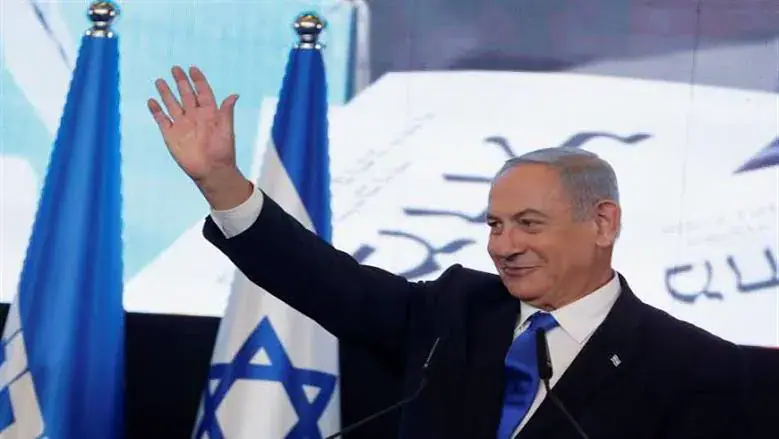
The latest Israeli elections have resulted in a stalemate, with Prime Minister Benjamin Netanyahu's right-wing bloc leading but failing to secure a majority. According to preliminary estimates, Netanyahu's bloc has secured around 53 seats out of 120 in the Knesset, while the opposition bloc led by Gadi Eisenkot has 48 seats. The Arab parties are expected to secure around 19 seats. This outcome has led to concerns about the possibility of prolonged political negotiations.
Netanyahu is expected to continue serving as the head of a caretaker government during the consultations led by Israeli President Isaac Herzog to appoint a person capable of forming a new government. The negotiations may result in a broad coalition or fail, leading to early new elections. Although the transitional government retains its official powers, it is expected to exercise restraint in major decisions. However, matters of security and military affairs may require exceptional decisions.
The performance of Arab parties in the elections is considered one of the significant developments, as their increased participation has enhanced their influence on the identity of the next government. However, their potential role in forming a coalition with the opposition is complicated by disagreements among the opposition forces regarding cooperation with Arab parties.
The election results have significant implications for Israel's security and international relations, particularly in light of the ongoing conflict in Gaza and tensions with Iran. The identity of the next government will play a crucial role in determining Israel's security approach and international relationships.
The preliminary results indicate that Netanyahu's bloc has an advantage, but it is not sufficient to form a stable government. Any coalition will need to secure the support of at least 61 members of parliament. This may lead to complex negotiations that could extend for weeks.
The crisis in the Israeli political arena has regional and international implications. The possibility of a broad coalition or new elections is still open, reflecting the ongoing divisions within Israel. The three possible scenarios are forming a coalition government, reaching a broader understanding, or heading to new elections if negotiations fail.
The Israeli elections have highlighted the challenges of producing a stable majority, reflecting the deep divisions within Israeli society. The outcome will have significant implications for Israel's future, including its security, economy, and international relationships.
Key points
- Netanyahu's bloc leads but lacks majority in Israeli elections
- Arab parties expected to play a crucial role in determining the next government
- Israeli elections face uncertainty, with possibility of new elections or coalition government