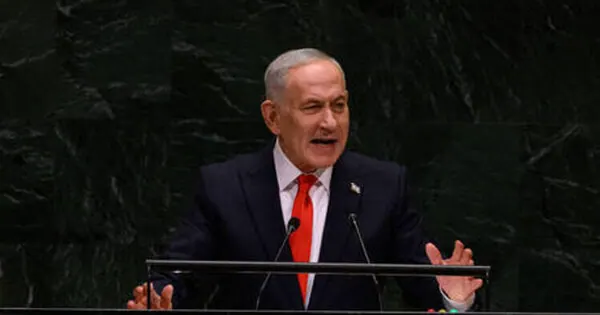
Israeli Prime Minister Benjamin Netanyahu is reportedly preparing a potential International Criminal Court (ICC) case against Turkish President Recep Tayyip Erdogan. This move is seen as a way for Netanyahu to gain leverage in their escalating dispute. The case would focus on alleged attacks against Kurdish minorities and claims that Erdogan's government funds Hamas.
The development follows Trkiye's announcement that it had asked Interpol to issue a Red Notice for Netanyahu after a Turkish court issued a warrant for his arrest. The warrant was issued on charges including genocide over Israel's interception of the Gaza-bound Global Sumud Flotilla earlier this year. Netanyahu responded by calling Erdogan "an antisemitic dictator" and accusing him of massacring Kurds and harboring Hamas members.
Netanyahu repeated his allegations in his UN General Assembly speech last week, describing Trkiye as "the latest country to become a super spreader of antisemitic lies." Trkiye's communications director, Burhanettin Duran, dismissed the remarks as "baseless accusations." The ICC was established under the Rome Statute, which entered into force in 2002, to prosecute genocide, war crimes, and crimes against humanity.
Israel is more likely to pursue the case through a third party, although there is also a possibility that it could file the case directly. However, Israel hopes to avoid taking either step and "aims to use the existence of the case as leverage against Erdogan, effectively using it as a deterrent." Netanyahu himself faces an active International Criminal Court arrest warrant and does not recognize the court's jurisdiction.
In November 2024, the ICC issued an arrest warrant for Netanyahu, accusing him of using "starvation as a method of warfare," intentionally directing attacks against civilians in Gaza, and committing crimes against humanity. Neither Israel nor Trkiye is a party to the Rome Statute, while the United States - Israel's closest ally - is likewise not a party. Washington sanctioned ICC President Tomoko Akane and senior trial lawyer Abdoulaye Seye, accusing the court of exceeding its mandate.
The ICC said it "strongly rejects" the designations, calling them "a flagrant attack against the independence of an impartial judicial institution." The ICC has no means of enforcing the warrant on its own and relies on countries to carry out arrests. A July Economist/YouGov poll found that 49% of Americans thought the US should arrest Netanyahu if he entered the country.
The relationship between Israel and Trkiye has been strained in recent years, with both countries having significant differences in their policies. The potential ICC case against Erdogan is seen as a new development in their dispute. KEY_POINT: Netanyahu faces an active ICC arrest warrant himself. KEY_POINT: The ICC case would focus on alleged attacks against Kurdish minorities and Hamas funding. KEY_POINT: Israel hopes to use the case as leverage against Erdogan.