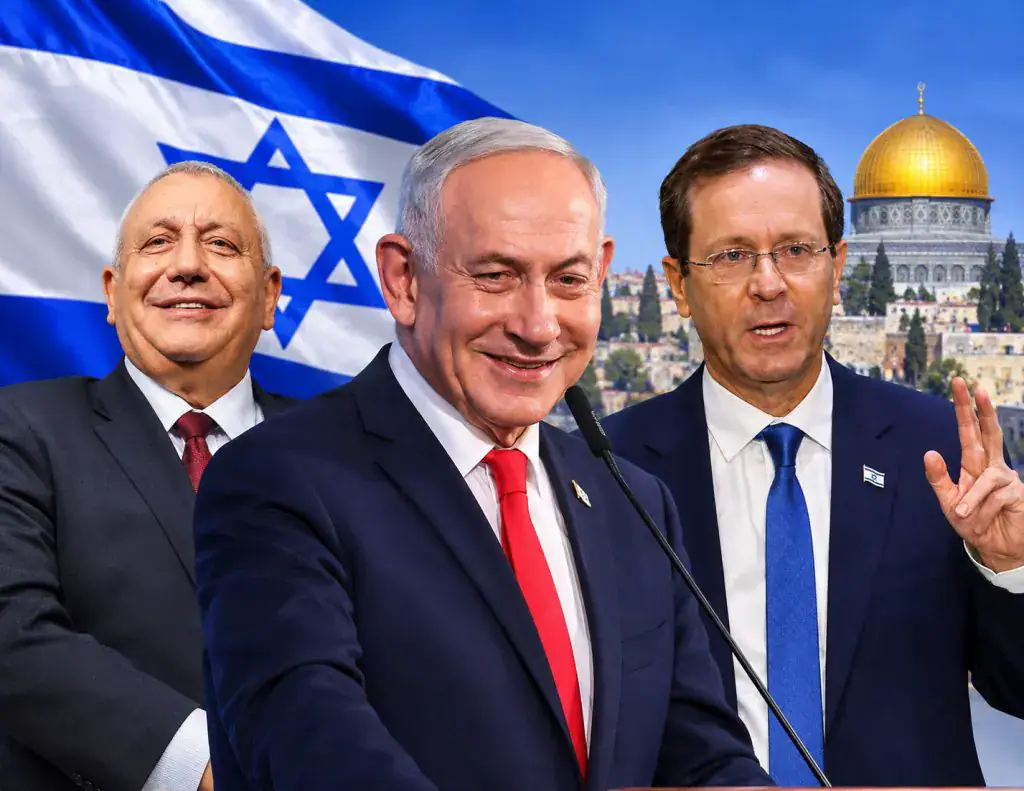
Israeli Prime Minister Benjamin Netanyahu has called for a national unity government with his political opponent, Gadi Eisenkot, in a video address. Netanyahu expressed optimism about their discussions, citing the need for a united front to address security challenges, particularly the threat from Iran. He suggested that the proposed government should include parties that recognize Israel as a Jewish state. Netanyahu's proposal comes as Eisenkot continues negotiations to form a new government after being tasked with forming a cabinet within 28 days.
Eisenkot responded by accusing Netanyahu of using political tactics to delay the formation of a new government. Eisenkot claimed that Netanyahu's call for unity was at odds with his divisive political record. According to the Knesset's current seat distribution, Eisenkot's coalition has 48 seats, while Netanyahu's bloc has 46. The remaining 26 seats are held by Arab and Orthodox parties that may abstain from voting, potentially allowing Eisenkot to form a government without securing an outright majority.
Netanyahu's proposal has been met with skepticism by Eisenkot, who emphasized that any future government must distance itself from radical politicians, particularly those associated with National Security Minister Itamar Ben Gvir. Eisenkot expressed willingness to cooperate with certain members of Netanyahu's Likud party and the Religious Zionism party, provided they demonstrate a genuine commitment to a unity government.
The likelihood of Eisenkot forming a direct coalition with Netanyahu appears low, given their past criticisms. Eisenkot previously condemned Netanyahu for what he described as a racist campaign against Arab parties in Israel. Furthermore, Eisenkot has urged the Likud party and its allies to support Matan Kahana as Speaker of the Knesset, rather than continuing to back Amir Ohana, a close Netanyahu ally.
The ongoing political tensions highlight the challenges facing Eisenkot as he seeks to form a new government. The issue of cooperation between Jewish and Arab parties remains a significant point of contention among Israeli politicians. Eisenkot was given an additional 14 days to secure a coalition, should his initial efforts fail.
Netanyahu's call for a national unity government has sparked debate about the potential benefits and drawbacks of such an arrangement. Some argue that a united government would strengthen Israel's security and stability, while others believe it could lead to further divisions and compromise.
The outcome of Eisenkot's coalition talks remains uncertain, with several possible scenarios emerging. If successful, his government could prioritize addressing pressing issues such as economic inequality and security concerns. However, failure to secure a coalition could lead to further political instability and potentially even new elections.
Key points
- Eisenkot must form a government within 42 days.
- Netanyahu's bloc has 46 Knesset seats.
- Eisenkot's coalition has 48 Knesset seats.