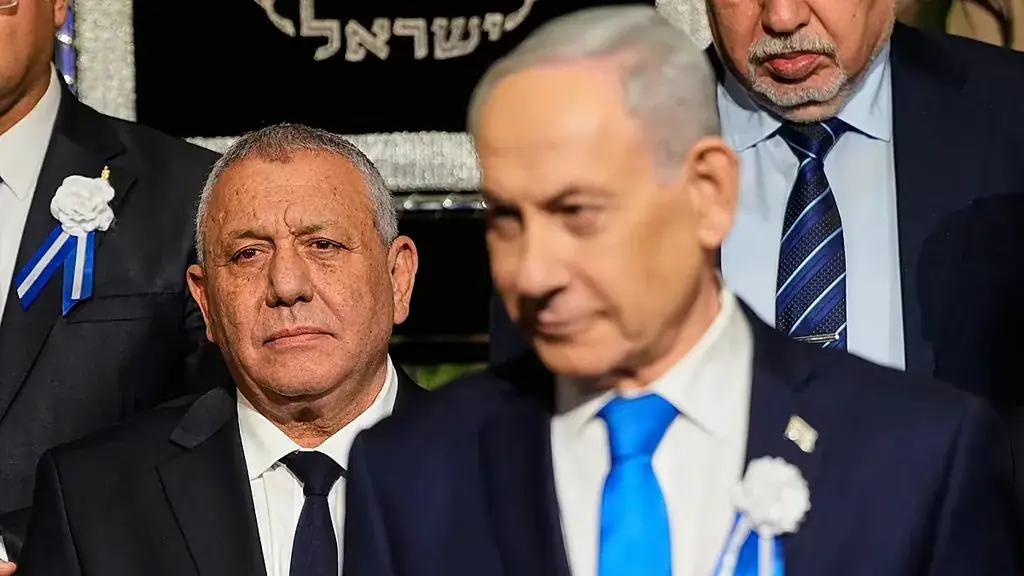
Israeli Prime Minister Benjamin Netanyahu met with his rival Gadi Eisenkot on Sunday morning for talks on forming a coalition government. The meeting, which started at 08:00 GMT at the Defense Ministry in Tel Aviv, began with a briefing on the security situation. This development comes as Israel struggles to form a government after recent elections resulted in no clear majority.
The talks between Netanyahu and Eisenkot aim to break the political deadlock. Eisenkot's party, Yashar, indicated that the meeting would focus on the security situation and potential coalition agreements. This move follows Netanyahu's sudden proposal on Saturday for a rotation government, where Eisenkot would serve as Prime Minister first. Netanyahu cited the need for a unified government to address Israel's "existential" challenges.
However, trust issues between Netanyahu and Eisenkot remain a significant hurdle. Eisenkot has accused Netanyahu and his party of delaying tactics to prevent a government from being formed. To reach an agreement, the two sides must resolve several major disputes, including the establishment of an independent investigation into security failures leading up to the Hamas attack on October 7, 2023.
Eisenkot and his allies also seek to amend several key laws passed under Netanyahu's government, including a judicial reform that weakened the independence of the Supreme Court. Netanyahu, on the other hand, presents a unity government as necessary for Israel's security, particularly in the face of threats from Iran. A national unity government could also help Netanyahu maintain political maneuverability amid his ongoing corruption trial.
The trial of Netanyahu has taken a positive turn for him, with judges questioning the solidity of key prosecution evidence last week. Former Prime Minister Naftali Bennett, a partner of Eisenkot, welcomed Netanyahu's proposal, emphasizing that the next government should be based on "parties representing the Zionist public."
Parallel negotiations are ongoing with Arab parties and ultra-Orthodox formations that could potentially join Eisenkot's Yashar party. On Saturday, Mansour Abbas, leader of the Israeli Arab party Raam, indirectly labeled Hamas a "terrorist" group, a move that could make his party more acceptable to Jewish majority voters.
The formation of a new Israeli government is crucial, given the current political uncertainty and security challenges. A unity government could provide a more stable leadership, but it will require compromise and trust between Netanyahu and Eisenkot. The outcome of these talks will have significant implications for Israel's future, both domestically and internationally.
Key points
- Netanyahu proposes rotation government with Eisenkot as Prime Minister first.
- Disputes over investigation into security failures and judicial reforms remain major hurdles.
- Unity government seen as necessary for addressing security challenges and maintaining political stability.