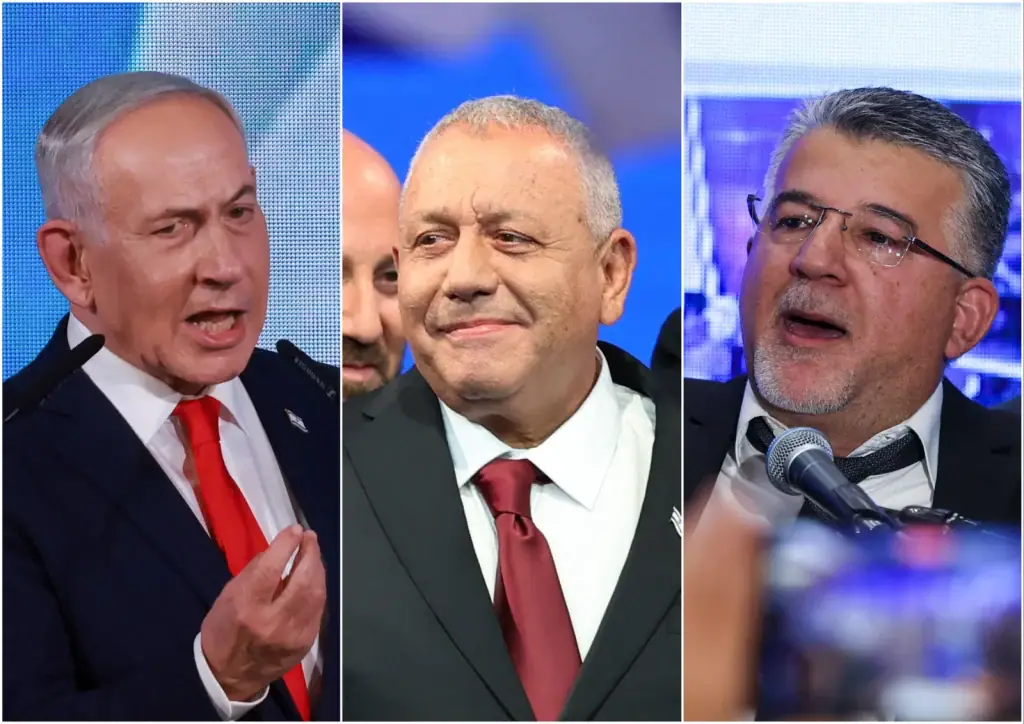
Israeli Prime Minister Benjamin Netanyahu has failed to secure a majority in the recent general election, with his right-wing coalition falling short of the required 61 seats to form a government. According to preliminary results, Netanyahu's coalition was expected to secure 53 seats, while the opposition bloc led by Gadi Eisenkot was expected to secure 48 seats. The Arab parties, on the other hand, made significant gains, securing 19 seats, which could give them a crucial role in coalition talks.
The election results have set the stage for complex coalition negotiations, with Netanyahu's Likud party and its allies needing to secure support from other parties to form a government. The opposition bloc, led by Eisenkot, has also expressed its intention to form a government, but its ability to do so remains uncertain. Yousef Jabareen, leader of the Joint List party, said that the election results demonstrated a desire for change, and that any party seeking to provide a genuine alternative to Netanyahu's government would need to engage with the Arab parties.
The gains made by the Arab parties have been attributed to their increased popularity among Arab voters, who turned out in large numbers to support their candidates. The Joint List party, which is a coalition of Arab parties, secured 15 seats, while other Arab parties secured an additional four seats. The party's leader, Jabareen, has called for dialogue with other parties, saying that the Arab parties are willing to engage in negotiations to form a government.
However, not all parties are open to the idea of working with the Arab parties. Some politicians within Eisenkot's opposition bloc have expressed reservations about forming an alliance with Arab parties, which could complicate coalition talks. Yair Golan, leader of the Labor party, has called for an alliance with the Arab parties, saying that it is essential to bridge the divide between Jewish and Arab voters.
Israeli President Isaac Herzog has expressed his hope that a government can be formed without the need for further elections. Herzog has urged all parties to engage in dialogue and find a solution that will allow a government to be formed. If coalition talks fail, Israel may be forced to hold another election, which would be the fifth in less than four years.
Netanyahu will continue to serve as caretaker prime minister until a new government is formed. His ability to form a government remains uncertain, and he will need to negotiate with other parties to secure the required majority. The Arab parties' gains have given them significant leverage in coalition talks, and their support will be crucial in determining the outcome of the negotiations.
The election results have also highlighted the deep divisions within Israeli politics, with the country facing significant challenges, including the ongoing conflict with Palestine and the economic impact of the COVID-19 pandemic. The formation of a new government will be crucial in addressing these challenges, and the coming days and weeks will be critical in determining the country's future direction.
Key points
- Netanyahu's coalition falls short of majority, Arab parties gain 19 seats.
- Coalition talks set to begin, with Netanyahu and opposition bloc seeking support.
- Arab parties' gains give them significant leverage in coalition negotiations.