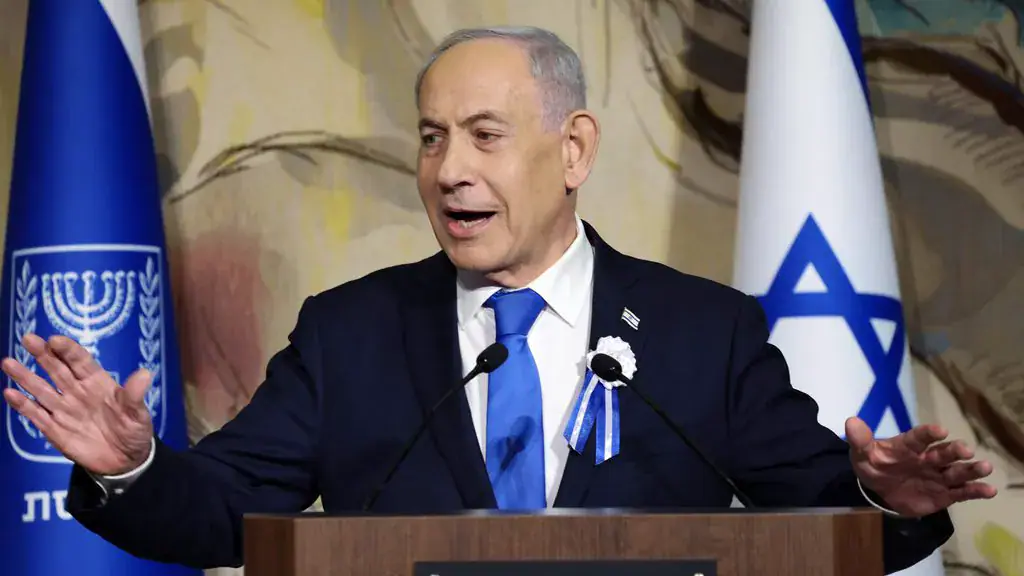
Israeli Prime Minister Benjamin Netanyahu has renewed his call for a national unity government with his rival Gadi Eisenkot, citing the need to ensure Israel's security in the face of threats from Iran. In a video statement, Netanyahu said that a unity government would bring together all parties that recognize Israel as the state of the Jewish people. He emphasized that this government would be essential in addressing the security challenges posed by Iran, which he described as a threat that would not hesitate to use nuclear weapons against Israel.
Eisenkot, who was tasked with forming a new government after the October 27 elections, has responded to Netanyahu's call, accusing him of using "tricks" to hinder the formation of a new coalition. Eisenkot stated that Netanyahu's public call for negotiations was unnecessary, as talks between their parties were already scheduled for Sunday. He also expressed concerns that Netanyahu's approach would only serve to divide and create tensions, rather than promote unity.
The negotiations for the next Israeli government have been complicated by the role of Arab Israeli parties, which hold 19 seats and could play a decisive role in forming a new coalition. Netanyahu's proposed unity government would bring together the main Jewish Zionist parties, excluding Arab Israeli parties, which he described as "supporters of terrorism". In contrast, Eisenkot has expressed willingness to work with members of Netanyahu's Likud party and the Religious Zionist Party, provided their commitment to unity is genuine.
A key challenge in forming a new government is the issue of leadership, with Netanyahu and Eisenkot having differing visions for the country's future. Eisenkot has stated that he would not serve under Netanyahu, while Netanyahu has proposed a rotation of the prime ministership between the two men. The two leaders have also differed on the issue of dealing with extremist groups, with Eisenkot calling for a "break with extremists" as a condition for participation in a new government.
The formation of a new Israeli government is crucial, as the country faces significant security challenges, particularly from Iran. The current political uncertainty has raised concerns about Israel's ability to address these threats effectively. With a deadline of December 6 to form a government, Eisenkot has a limited window to negotiate a coalition.
Other Israeli politicians have weighed in on the debate, with Finance Minister Bezalel Smotrich expressing hope that Netanyahu's call for unity would be reciprocated. Smotrich stated that his party would be a champion of national unity and responsibility. Meanwhile, Netanyahu's call for a unity government has been met with skepticism by some, who question whether it is a genuine attempt to promote national unity or a tactical move to consolidate power.
The situation remains fluid, with ongoing negotiations between Netanyahu and Eisenkot. The outcome will have significant implications for Israel's future, particularly in terms of its security and relations with neighboring countries. As the deadline for forming a government approaches, the international community is watching closely, aware that stability in Israel has far-reaching consequences for regional and global security.
Key points
- Netanyahu's proposed unity government would exclude Arab Israeli parties, which hold 19 seats and could play a decisive role in forming a new coalition.