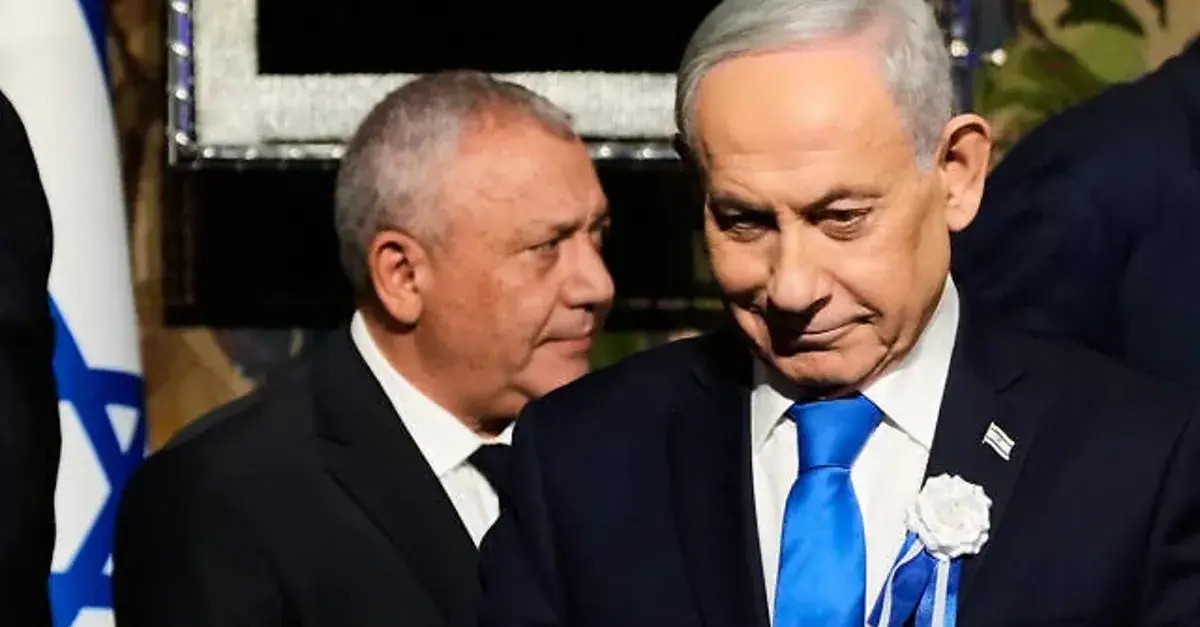
Israeli Prime Minister Benjamin Netanyahu and Blue and White party leader Gadi Eisenkot met at the Israeli Defense Ministry in Tel Aviv to discuss forming a national unity government. This comes after Netanyahu offered to rotate the prime ministership with Eisenkot. Netanyahu's offer is seen as a significant political concession. The meeting is a crucial step towards forming a new government after the October 27 elections.
Netanyahu's party, Likud, lost its parliamentary majority in the recent elections. Eisenkot's Blue and White party has been making progress in coalition talks. He has signed agreements with Israel Our Home party leader Avigdor Lieberman and Democratic Camp party leader Yair Golan. However, Eisenkot still needs to secure more seats to achieve the required 61-seat majority in the 120-seat Knesset.
Eisenkot gave Netanyahu and Likud a 24-hour deadline to prove the seriousness of their offer. The two leaders agreed to meet in the city of Herzliya to discuss the proposal. This comes after Eisenkot accused Likud of refusing to engage in serious negotiations for nearly three weeks. Netanyahu's offer includes him serving as alternate prime minister under Eisenkot.
The proposal has sparked divisions within the opposition camp. Yesh Atid party leader Yair Lapid rejected the offer, calling it an attempt to sabotage the formation of a change government. On the other hand, New Hope party leader Naftali Bennett welcomed the initiative but emphasized the need to verify Netanyahu's sincerity. Bennett warned that negotiations should not be used as a means to delay the formation of an alternative government.
The divisions have also extended to the Ultra-Orthodox party Yahadut Hatorah. Some members have expressed support for a unity government with Likud, while others have rejected Netanyahu's proposal. The disagreements between Netanyahu and the Ultra-Orthodox parties center around the conscription of religious students into the Israeli army.
Netanyahu is keen to include Yahadut Hatorah and Shas in the proposed unity government. He has pledged to reach an understanding on military conscription to secure the support of his former allies. Israeli President Isaac Herzog tasked Eisenkot with forming a government on November 8, after 67 Knesset members recommended him for the role.
The talks between Netanyahu and Eisenkot are seen as a significant development in Israeli politics. A unity government could have far-reaching implications for the country's future. The outcome of the negotiations remains uncertain, with many challenges still to be overcome.
Key points
- Netanyahu offers to rotate prime ministership with Eisenkot
- Eisenkot seeks to secure 61-seat majority in Knesset
- Proposal sparks divisions within opposition camp
Reporting sources
- بدء المفاوضات المباشرة بين نتنياهو وآيزنكوت لتشكيل حكومة وحدة · Al-Qahera News