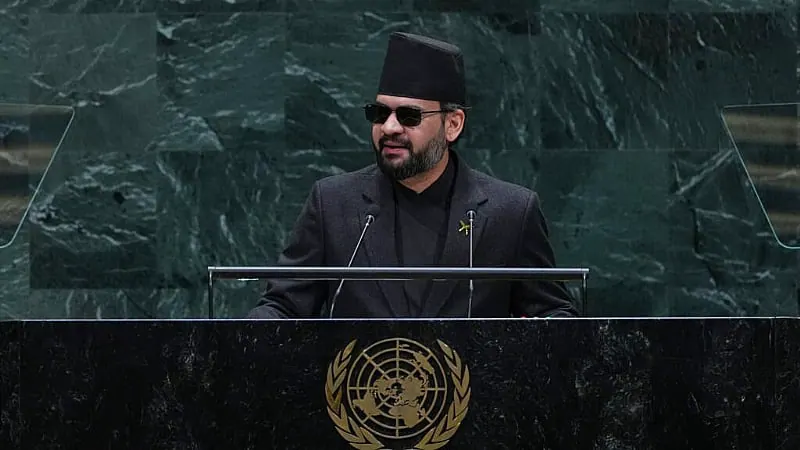
Nepal's Prime Minister Balendra Shah addressed the 81st session of the United Nations General Assembly on September 24, 2026, where he warned that his country's recent catastrophic floods were a warning to the world about the rising dangers of climate change. The floods, triggered by a glacial mountain collapse, resulted in over 1,400 deaths and 6,000 people still missing. Shah emphasized that Nepal, which contributes less than 0.1 percent of global greenhouse gas emissions, is paying a heavy price for a crisis it did not create.
Shah stated that a warming climate is destabilizing the fragile Himalayan ecology, melting permafrost and glaciers, and accelerating hazards. He proposed the creation of a "Himalaya Climate Resilience Mechanism," which would include Nepal and its neighbors India and China, to share satellite data and expertise, monitor glacial lakes, and strengthen joint early warning systems. This mechanism aims to help Nepal adapt to climate change and build resilience against future crises.
The recent floods in Nepal have had a devastating impact on the country, with the economic devastation estimated to be in the billions of dollars. Scientists have described the event as a "compound crisis" in which local geological instability combined with long-term warming has led to glacier retreat and permafrost thaw. Shah urged the international community to help bear the cost of helping his country adapt to climate change, as Nepal cannot build resilience alone against a crisis made worse by the failure of global governance.
Nepal has asked the UN's Loss and Damage fund for $20 million in aid, the maximum allowed, but this is a tiny fraction of what it needs. A preliminary assessment by the government has placed the cost of the disaster at $5 billion. The fund, established in 2022 in the aftermath of catastrophic floods in Pakistan, has yet to make even its first disbursement, and observers see Nepal as a key test of its credibility.
Earlier this week, the United States pledged an additional $31 million in new flood recovery support. Nepal's foreign minister Shisir Khanal told AFP that the G7 informally promised support at a meeting on Wednesday, and Britain has also vowed to help. This international support is crucial for Nepal as it works to recover from the devastating floods and build resilience against future climate-related disasters.
Prime Minister Shah, a 36-year-old ex-rapper, swept to power six months ago on a wave of youth-led anti-corruption protests, buoyed by optimism for change. However, the recent disaster has pushed climate diplomacy to the center of his premiership, overshadowing the anti-corruption agenda. Shah's leadership during this crisis will be closely watched as Nepal navigates the challenges of climate change and seeks international support.
As Nepal continues to grapple with the aftermath of the floods, the international community is faced with the challenge of providing adequate support to help the country adapt to climate change. The success of the Loss and Damage fund and the implementation of the proposed Himalaya Climate Resilience Mechanism will be critical in determining Nepal's ability to build resilience and recover from future disasters.
Key points
- Nepal's PM Balendra Shah urges international community to help his country adapt to climate change
- Recent floods in Nepal resulted in over 1,400 deaths and $5 billion in economic devastation
- Nepal has asked the UN's Loss and Damage fund for $20 million in aid, but needs $5 billion to recover from the disaster