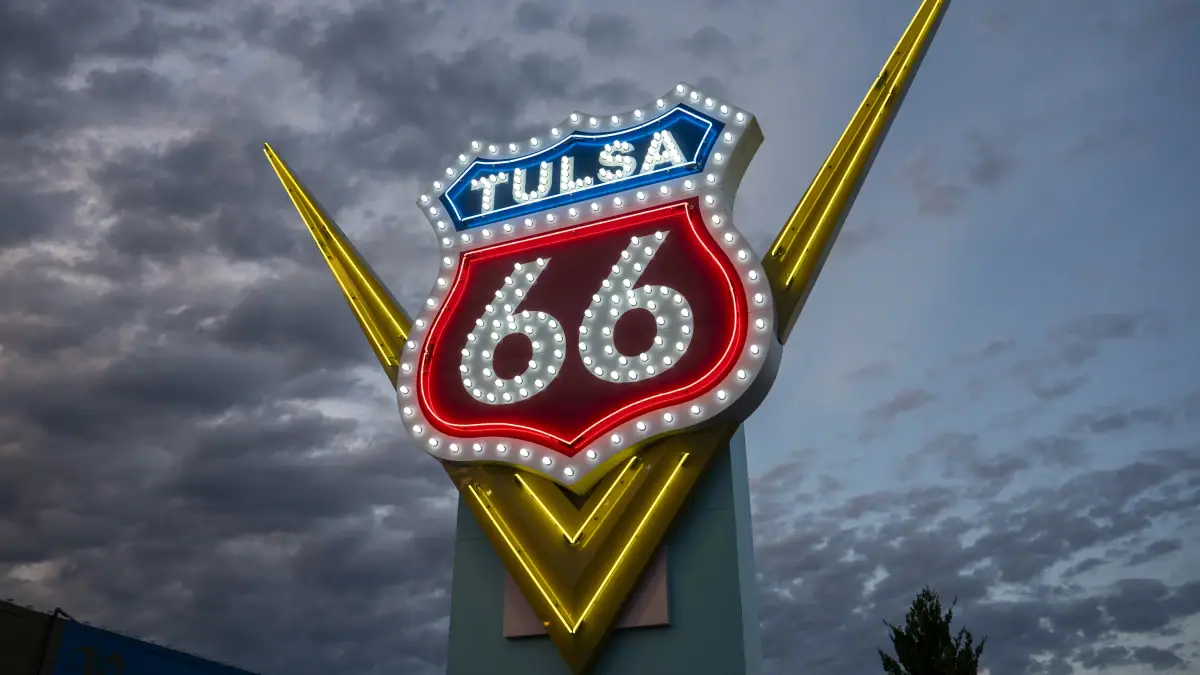
Route 66, which opened in November 1926, was once an iconic road trip destination, connecting cities and small towns from Chicago to Los Angeles. The road's heyday featured neon signs as radiant jewels scattered along the roadside. Georges Claude, a Parisian, invented the idea of running electricity through tubing filled with neon gas in 1910. The first neon sign arrived in the US in 1922, at a Packard car dealership, and locals were amazed.
Claude sold franchises, including one to what is now Claude Neon Federal Signs, founded 100 years ago. The company, still in operation in Tulsa, is the largest sign company in Oklahoma. Its artisans, known as "neon benders," heat glass tubes in a fire and bend them by hand to form shapes and letters. Tom Wolski, a neon bender, said his work is both beautiful and dangerous, requiring attention to extreme electricity, fire, phosphorus, and mercury.
However, fewer companies have commissioned neon benders due to the high cost. Many have turned to LEDs, which are less expensive to make and operate and less dangerous. Joe Kesterson, senior designer at Claude Neon Federal Signs, maintains that LEDs are not as beautiful as neon. Neon glows like a candle, while LED lights are brighter and sharper. Kesterson also explained that neon lights are not all neon gas, with warm colors usually having neon and cool colors made using argon gas.
Route 66 served as the primary route for migrating farmworkers during the Dust Bowl and later became a military transport corridor during World War II. The traffic led to gas stations, restaurants, and motels, which in turn led to vacationers. Businesses with neon signs seemed modern and new, signifying to travelers that they were clean and safe. Kathleen Franz, associate director for curatorial affairs at the National Museum of American History, said neon signs were part of the mystique of Route 66.
The 1950s brought Googie-style signs with Space Age shapes, and companies learned how to animate their signs. Tulsa was particularly known for its large signs, including the 1934 "Meadow Gold" sign, which was originally built by Claude Neon Federal Signs and restored about 70 years later. However, with the construction of new interstate highways, Route 66 was eventually decommissioned, and many neon signs were turned off, sold, or trashed.
In 1999, a law authorized the National Park Service Route 66 Corridor Preservation Program to preserve and commemorate the road. Communities along the old route started restoring roadside attractions, including neon signs. In 2004, the Meadow Gold sign was saved, and CNF Signs rebuilt the scaffolding and restored the porcelain letters that house the neon. The sign was relit and placed in what is now the Meadow Gold section of town in 2009.
Today, there are over 100 neon signs in Tulsa, including re-created vintage ones in Neon Sign Park. The park features signs otherwise lost to history, such as the Will Rogers Motor Court and the Tulsa Auto Court. While the signs are not visible from the modern highway, they are still glowing, bringing back the nostalgic charm of Route 66.
Key points
- The restoration of neon signs along Route 66 is part of a larger effort to preserve and commemorate the road's history and charm.