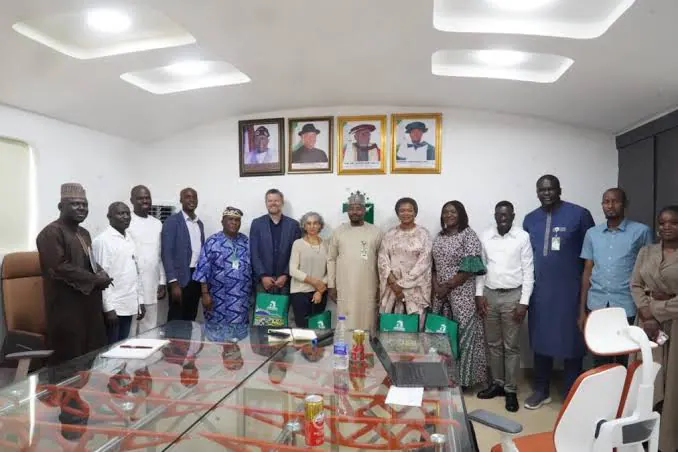
The Nigeria Civil Aviation Authority (NCAA) has partnered with the African Aviation and Aerospace University (AAAU) to develop the technical capacity and professional expertise required for Nigeria's emerging Sustainable Aviation Fuel (SAF) ecosystem. This collaboration aims to position Nigeria at the forefront of green aviation. The partnership follows a visit by the NCAA Environment Team to AAAU for discussions on SAF development and capacity building.
The NCAA Environment Team, led by Jon McKechnie, an NCAA SAF Technical Expert and an ICAO Consultant, was received by the Ag. Vice-Chancellor of AAAU, Dr. Mustapha Sheikh Abdullahi. During the visit, Abdullahi provided an overview of the University, highlighting its establishment, academic programmes, and growing focus on aviation, aerospace, and environmental sustainability. He also emphasized the role of the African Centre for Climate Change and Aviation Decarbonization (ACCCAD) in advancing knowledge, research, and capacity development in climate change and aviation decarbonization.
The discussions built on preliminary efforts initiated last year to explore Nigeria's potential for Sustainable Aviation Fuel development. Studies have identified significant opportunities for SAF production from available sustainable resources, providing a basis for further consideration of the technical, academic, and institutional requirements necessary to develop a functional SAF ecosystem in Nigeria. The partnership aims to examine the potential role of AAAU as a knowledge and training base for SAF capacity development.
The proposed Training of Trainers (ToT) programme is designed to develop a pool of professionals and subject matter experts capable of transferring knowledge and supporting wider capacity development in the SAF sector. This programme is consistent with the University's aviation and environmental sustainability mandate and the work of ACCCAD, particularly in the areas of climate change, aviation decarbonization, and professional capacity development.
The NCAA Team leader discussed the structure and requirements of the proposed programme, including the technical and knowledge areas to be covered and the need for an appropriate academic foundation to support the initiative. The teams comprising the leadership of ACCCAD and other relevant experts within AAAU will work with the NCAA technical team to further define areas of collaboration, including training, subject-matter expertise, knowledge exchange, and the proposed Training of Trainers programme.
This partnership bridges the gap between regulatory oversight and academic research, building the skilled workforce needed to drive Nigeria's green aviation transition. By uniting the regulator with academic minds, the initiative clears a practical path toward a lower-emission airspace and a more sustainable aviation sector. The collaboration among regulators, academic institutions, technical experts, industry stakeholders, and other relevant partners is crucial, given the multidisciplinary nature of Sustainable Aviation Fuel development.
The partnership between NCAA and AAAU is a significant step towards achieving a sustainable aviation sector in Nigeria. The development of a functional SAF ecosystem will not only reduce emissions but also create new opportunities for economic growth and development. As the aviation sector continues to grow, the need for sustainable practices becomes increasingly important, and this partnership is a positive step in the right direction.
Key points
- The NCAA and AAAU partnership aims to develop the technical capacity and professional expertise required for Nigeria's emerging Sustainable Aviation Fuel ecosystem.
- The proposed Training of Trainers programme is designed to develop a pool of professionals and subject matter experts capable of transferring knowledge and supporting wider capacity development in the SAF sector.
- The partnership bridges the gap between regulatory oversight and academic research, building the skilled workforce needed to drive Nigeria's green aviation transition.