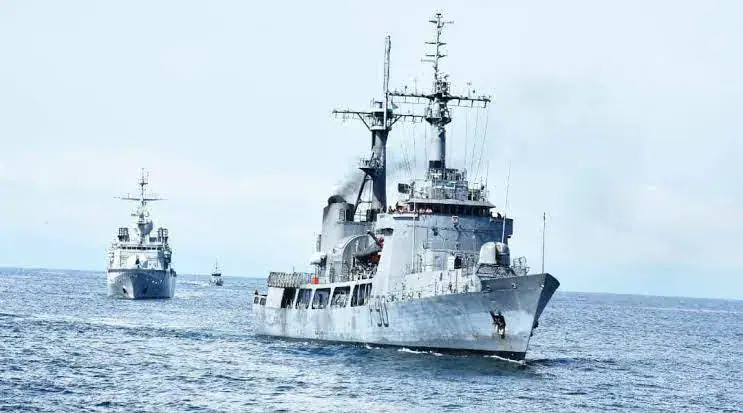
The Nigerian Navy has emphasized the need for stronger collaboration among maritime security agencies, improved intelligence-sharing and integration of defence systems to tackle emerging threats in Nigeria's maritime domain and the wider Gulf of Guinea. This call was made by Commodore Isa Ahmed, who represented the Nigerian Navy at a panel discussion at the 2026 Africa International Defence Exhibition (AFRIDEX) in Lagos. Ahmed stressed that effective maritime security required more than just acquiring sophisticated equipment.
Ahmed presented a paper titled, "Interoperability at Sea: Strengthening Maritime Security Through Systems, Standards and Integration," at the exhibition. He highlighted that the increasing complexity and transnational nature of maritime threats made it imperative for naval forces, government agencies and regional institutions to strengthen communication, share intelligence and coordinate operations. The commodore identified piracy, armed robbery against ships, maritime trafficking, illegal fishing and illicit movement of goods as major threats that exploit gaps in surveillance, information-sharing and law enforcement across national maritime boundaries.
According to Ahmed, detecting suspicious maritime activities is insufficient unless the information is properly assessed, communicated to the appropriate authorities and translated into lawful operational action. He identified systems, standards and integration as the three essential pillars of maritime interoperability. On systems, he advocated linking existing surveillance and information platforms to provide a comprehensive picture of activities at sea. This includes radar, Automatic Identification System (AIS) data, satellite-based surveillance, intelligence databases and maritime operations centres.
Ahmed stressed the importance of common technical procedures, terminology, data formats and incident-reporting systems to ensure that information exchanged between agencies could be understood and acted upon promptly. He also called for robust information-security measures, including access controls and clear rules governing the sharing and use of sensitive information. The aim, he stated, was not unrestricted information exchange but the secure and appropriate exchange of information with those who have the authority and operational need to receive it.
The commodore recommended regular joint exercises, operational simulations and reviews of security incidents to identify weaknesses and improve cooperation among maritime stakeholders. He highlighted the complementary roles of the Nigerian Navy, the Nigerian Maritime Administration and Safety Agency (NIMASA), the Nigerian Ports Authority (NPA) and law-enforcement agencies. Their distinct statutory responsibilities, he noted, required effective coordination whenever their mandates overlapped.
Ahmed identified the Yaoundé Architecture, established following the 2013 Yaoundé Summit, as a critical framework for regional cooperation against piracy, armed robbery against ships and other illicit maritime activities in West and Central Africa. He, however, warned that establishing regional coordination centres and information-sharing platforms would not automatically guarantee effective cooperation without timely intelligence, adequate institutional capacity and clear operational procedures.
Ahmed urged African countries to make interoperability a fundamental requirement in defence procurement rather than an afterthought. He concluded that stronger interoperability would protect national interests, secure maritime commerce and promote stability across the Gulf of Guinea, urging stakeholders to translate regional commitments into practical cooperation. Progress, he said, should be measured by improvements in maritime awareness, the quality of shared intelligence, operational decision-making, and the speed and effectiveness of coordinated responses.
Key points
- Nigerian Navy calls for stronger collaboration among maritime security agencies.
- Improved intelligence-sharing and integration of defence systems essential for effective maritime security.
- Interoperability must be a fundamental requirement in defence procurement.