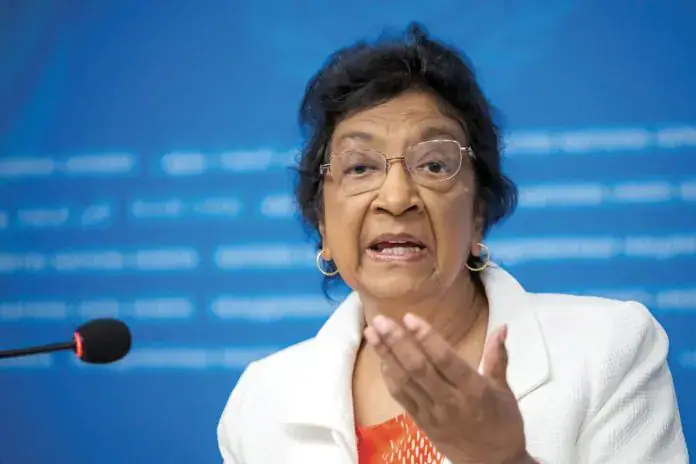
In a recent interview with Algerian international channel AL 24 News, Navi Pillay, the 2026 Nobel Peace Prize laureate and president of the Independent International Commission of Inquiry on occupied Palestinian territories, stressed that a just solution to the Sahrawi problem can only be achieved through the right to self-determination. Pillay expressed deep regret that the crisis has become a longstanding conflict affecting the Sahrawi people, with no apparent solution on the horizon.
Pillay called for intensified mobilization in support of the Sahrawi people's right to self-determination, urging continued and absolute support. She emphasized the need for collective action and ongoing struggle between governments and civil society to make popular demands clear and manifest before international institutions. The Sahrawi issue is a matter of colonization, a subject permanently on the agenda of the United Nations and the Security Council, which has recently discussed the dossier.
Pillay also warned about the dangers of interference by influential countries in international justice, citing concerns about attacks on the sovereignty of international law. Many global political figures share her concerns, particularly regarding the obstacles created by former colonial powers and the US to block the work of the International Criminal Court on the ongoing genocide in Palestine. Pillay argued that the right of veto "must be rethought."
Pillay highlighted that peoples worldwide seek not only peace but also justice and accountability, citing the Genocide Convention's obligation for states to prevent this major crime wherever it occurs. She reviewed her 60-year professional career, noting her Nobel Prize as a step towards addressing injustice resulting from persistent discrimination against women. Pillay is one of five personalities in South Africa to have received this honor.
The 2026 Nobel Peace Prize laureate criticized the UN Security Council's inability to promote peace, citing the use of veto power by some member states to protect their allies as an affront to people's aspirations for a just world. Pillay called for reforming the "veto" mechanism and avoiding its use in cases of serious human rights violations. Many countries advocating for UN reform share this stance.
On the Palestinian issue, Pillay defended the commission's report, which concluded that genocide is occurring and continues in the Gaza Strip, based on evidence collected over two years. She explained that the commission's legal conclusion was based on hate speech and direct targeting of civilians by Israeli leaders, despite Israeli authorities preventing the commission from investigating in Palestinian territories.
Pillay concluded that the commission's findings have high authority and credibility due to her experience as a judge at the International Criminal Tribunal for Rwanda. She expressed confidence that the International Criminal Court will continue its work on the Gaza genocide, citing the example of the end of apartheid in South Africa through collective action and refusal to tolerate institutional racism.
Key points
- Navi Pillay emphasizes self-determination as crucial to resolving the Sahrawi conflict.
- Pillay criticizes international inaction and interference in justice, particularly regarding the Israeli-Palestinian conflict.
- The 2026 Nobel Peace Prize laureate calls for reforming the UN Security Council's veto mechanism to promote justice and accountability.