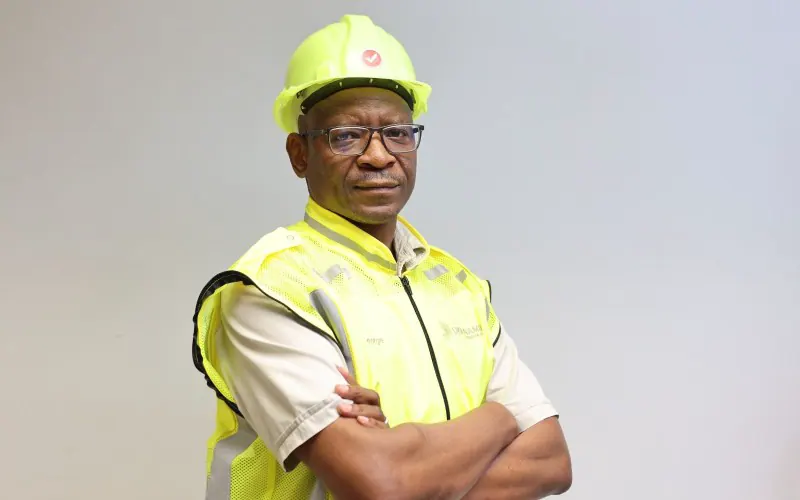
Navachab Gold Mine, located in Karibib, Namibia, is planning a significant expansion worth an estimated N$6.67 billion (US$400 million). The project includes the construction of a new plant, underground exploration, and increased local procurement. This move aims to strengthen the mine's contribution to Namibia's economy. The mine's management believes that this expansion will not only increase production but also create more opportunities for local businesses to grow and become competitive suppliers.
In 2025, Navachab spent approximately N$2.962 billion on procurement, with N$2.376 billion recorded as expenditure in Namibia and around N$41 million spent locally in Karibib. Executive Director George Botshiwe stated that the mine's approach to procurement focuses on sourcing locally whenever possible. This strategy supports local companies and enables them to grow into competitive suppliers capable of serving not only the mine but also other mining operations and sectors.
Navachab achieved its highest annual gold production in 2025, producing 4,067 kilograms, a 4% increase from 3,902 kilograms in 2024. The mine's mining production reached 21.1 million tonnes, while processing production stood at 130.7 thousand ounces. Botshiwe attributed the record production to the mine's efforts to improve its operations and prepare for the future. He emphasized that the mine's goal is to improve safety and efficiency in its mining and processing operations.
Navachab began commercial production in 1989 and currently operates as a conventional open-pit gold mine, with silver produced as a by-product. The mine was acquired by QKR from AngloGold Ashanti in 2014 and is owned by QKR Mineral Holdings (93.73%) and Epangelo (6.27%). The mine has mineral reserves of 2.43 million ounces at 0.99 grams per tonne and mineral resources of 5.16 million ounces at 1.14 grams per tonne.
The mine has commenced trackless underground mining and plans to upgrade about 350,000 ounces of inferred material into the indicated category through exploration drilling and geotechnical drilling. The programme involves approximately 22 kilometres of exploration drilling and four kilometres of geotechnical drilling. A final decision on full-scale underground production is expected by the end of 2027.
Navachab is also studying a proposed 1,000-tonne-per-hour flotation project as part of its broader plant expansion study. The project indicates potential to increase recovered ounces from approximately 1.6 million to 3.5 million ounces and annual gold production from about 140,000-150,000 ounces to between 220,000 and 230,000 ounces. The expansion could also increase the mining rate from approximately 30 million tonnes per annum to between 60 million and 65 million tonnes.
Beyond production, Navachab's economic footprint extends to taxes, wages, skills development, and community investment. In 2025, the mine spent N$2.3 million on training and skills development and provided practical industry exposure to more than 100 interns. The operation currently employs 911 people and spent more than N$33 million on corporate social investment projects in 2025. Botshiwe emphasized that a successful operation must be safe, responsible, and productive.
Key points
- Navachab Gold Mine plans to invest N$6.67 billion in expansion projects to increase production and local procurement.
- The mine achieved its highest annual gold production in 2025, producing 4,067 kilograms.
- Navachab's expansion plans include underground exploration and a proposed 1,000-tonne-per-hour flotation project.