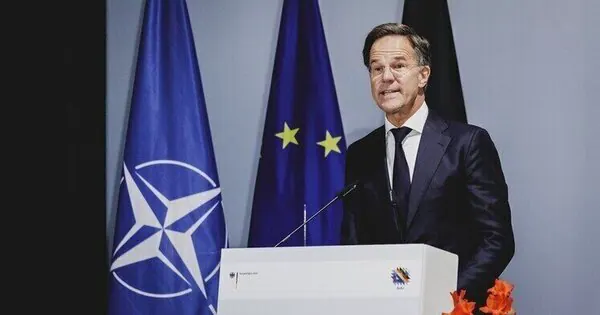
NATO Secretary General Mark Rutte has called on European nations to take greater responsibility for security in the Middle East. Speaking at a Chicago Council on Global Affairs event in Iowa, Rutte argued that the region is "Europe's backyard" and that European members should spend less on social programs and more on the military. He described the US-Israeli war on Iran as "necessary" but acknowledged that Europeans did not have enough capabilities to launch it themselves.
Rutte's remarks come as Washington pushes for a reorganization of NATO, dubbed NATO 3.0, under which European members would sharply increase military spending and production while assuming "primary responsibility for the conventional defense of Europe." The US-Israeli war on Iran, launched in late February, caused major friction within NATO as several European members resisted supporting Washington's belligerence. Spain refused to allow American warplanes to use its bases for the campaign, drawing US President Donald Trump's ire.
Germany and the UK described the conflict as "not our war," while stopping short of condemning the US and Israel. Trump has since repeatedly accused European allies of failing to meet their NATO commitments and claimed the bloc "was not there when we needed them." In April, US War Secretary Pete Hegseth said NATO's future was uncertain and Washington could not currently reaffirm its commitment to collective defense.
Rutte also argued that the burden within NATO was unfair because European members spend heavily "on pensions and welfare," while Washington has to devote more resources to weapons. He described raising NATO's defense spending target from 2% to 5% of GDP as "the fairness element" and part of an "equalizing" process. This proposal aims to address the imbalance in defense spending between European members and the US.
The NATO chief's comments have sparked debate about the role of European nations in global security. Rutte offered to help "protect the United States from threats of Russia" and China and prevent the Arctic "from becoming militarized by the Russians and the Chinese." Russian Foreign Minister Sergey Lavrov said last month that Moscow was primarily interested in "preserving the Arctic as an area of peace and cooperation" and accused NATO of "driving the region towards militarization."
European Commission President Ursula von der Leyen has proposed using increased EU military spending on "Arctic-ready equipment." The proposal highlights the growing concern about the Arctic region's security and the need for European nations to take a more active role in global affairs. Rutte's call for greater European responsibility in the Middle East and beyond reflects a shift in the global security landscape.
As NATO continues to evolve, European nations will need to reassess their priorities and commitments to collective defense. The debate sparked by Rutte's remarks is likely to continue, with many questioning the feasibility and implications of increased military spending and a greater role in global security. The future of NATO and European security will depend on the outcome of this debate.
Key points
- European nations should take greater responsibility for security in the Middle East.
- NATO's defense spending target may be raised from 2% to 5% of GDP.
- The US-Israeli war on Iran has caused friction within NATO.