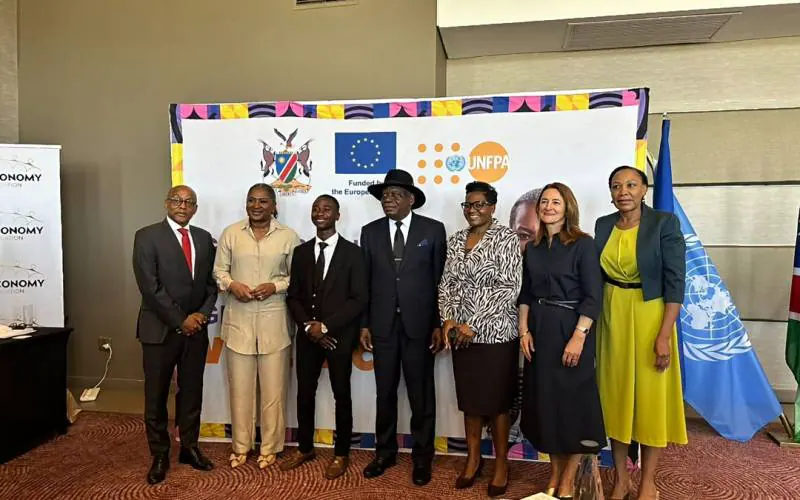
First Gentleman Lt (Rtd) Epaphras Denga Ndaitwah has emphasized the need for a unified approach to address the challenges facing boys and men in Namibia. Speaking at the Male Engagement Symposium in Windhoek, Ndaitwah warned that fragmented programs have limited impact. He stressed that organizations working with men and boys often operate in isolation, resulting in duplicated efforts and inconsistent messaging. Ndaitwah's comments come amid concerns over disparities in boys' educational outcomes and mental wellbeing.
According to Ministry of Education statistics, 8,720 boys dropped out of school in 2023, out of a total of 17,152 learners. Research by the University of Namibia found that boys have lower promotion and survival rates, and higher repetition, failure, and school-leaving rates than girls. The study recorded an average promotion rate of 75.1% for boys, compared to 78.4% for girls. These disparities persist in higher education, with men accounting for 22,715 out of 66,656 students enrolled in 2020.
Ndaitwah also raised concerns about the mental wellbeing of men and boys, citing a culture of silence around male mental health. Police recorded 486 suicide cases in the 2025/26 financial year, with 390 adult men, 83 adult women, nine boys, and four girls. He launched the DEN Impact Foundation on August 18, 2026, to address the "boy child crisis" in Namibia and globally. The foundation focuses on sport, agriculture, technical training, skills development, and character building.
Ndaitwah emphasized that efforts to support boys should not compromise gains made for girls and women. Instead, he called for interventions that address the specific needs of both. He stressed that coordination in male engagement programs can transform isolated efforts into unified, gender-transformative interventions. Ndaitwah urged stakeholders to work together to address the challenges facing boys and men.
Gender Equality and Child Welfare Minister Emma Kantema stated that the symposium aligns with the ministry's Third National Gender Equality and Equity Policy 2025-2035 and its Strategic Plan 2025-2030. The policy aims to create a gender-just society where men, women, boys, and girls enjoy equal rights and dignity. Kantema noted that Namibia ranks fourth globally and first in Africa in the World Economic Forum's 2026 Global Gender Gap Index.
Chairperson of the Children's Parliament Education and ICT Committee Gerson Neumbo said the symposium is timely, particularly given concerns over boys' educational outcomes. Ndaitwah pointed to Namibia's success in coordinating action during the HIV response, achieving significant results through collaborative efforts. He called on government, civil society, schools, communities, traditional, and faith-based organizations to make concrete commitments to address the challenges facing boys and men.
Ndaitwah concluded by emphasizing the importance of collective action to address the challenges facing boys and men. He urged stakeholders to work together to develop and implement effective programs that address the specific needs of boys and men. By doing so, Namibia can make progress towards creating a more equitable society where men, women, boys, and girls enjoy equal rights and dignity.
Key points
- - First Gentleman Lt (Rtd) Epaphras Denga Ndaitwah calls for coordinated approach to challenges facing boys and men in Namibia. - Boys in Namibia face disparities in educational outcomes, with lower promotion and survival rates, and higher repetition, failure, and school-leaving rates than girls. - Ndaitwah launches DEN Impact Foundation to address "boy child crisis" in Namibia and globally.