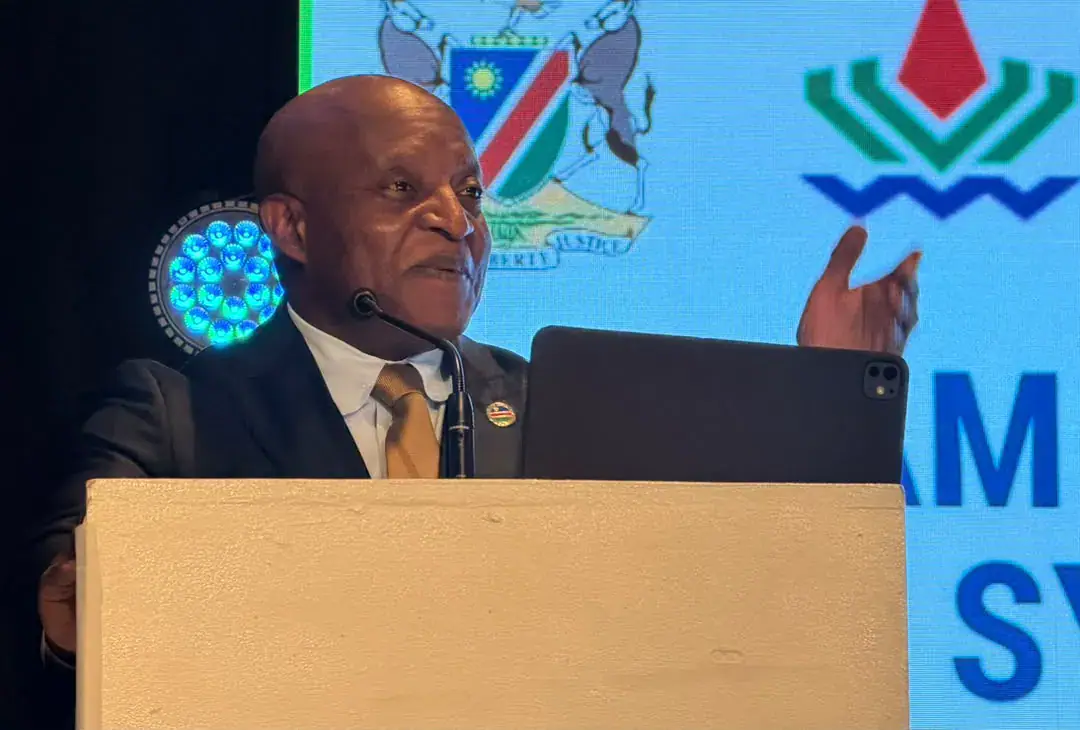
Namibian Prime Minister Elijah Ngurare has called on mines in Erongo and ǁKharas to contribute to funding small desalination plants for villages struggling with brackish borehole water. He made the appeal during the 3rd Namibia Regional Water Symposium in Swakopmund, highlighting that the technology has already been proven in Erongo. According to Ngurare, three reverse-osmosis units installed on communal farms in the Spitzkoppe area cost around N$1 million and successfully converted brackish water into drinking water.
Ngurare drew a comparison between the cost of the small desalination plants and the refreshments served at conferences, stating that the budget for refreshments alone could be sufficient to provide a small desalination plant. He challenged the mines and businesses with a healthy financial position to get involved and contribute to the installation of two, three, four, or five small desalination plants. This appeal comes as a significant development in addressing the water challenges faced by communities in these regions.
The Prime Minister had previously instructed NamWater to supply water to drought-affected constituencies in Omusati this week. He confirmed that the same directive applies to Erongo, emphasizing the need to ensure that water flows to those in need. Ngurare specifically mentioned Uis and Otjimbingwe as areas where the government has the capacity to provide water. He tasked the Minister and Executive Director of Agriculture, Fisheries, Water, and Land Reform to revisit planning and ensure that the Directorate for Rural Water Supply has the necessary resources to act.
Ngurare expressed concern over the limitations faced by the Directorate for Rural Water Supply, citing the lack of vehicles as a significant hindrance to their ability to access and maintain infrastructure. He emphasized the importance of addressing these challenges to ensure effective water supply. The Prime Minister also highlighted that funding for the water sector has increased to over N$1 billion, representing a nearly 39% increase, with more than N$867 million allocated for the development, maintenance, and upgrading of water infrastructure.
However, Ngurare criticized development partners and consultants for delaying urgent projects through prolonged studies. He stressed the need for immediate action, stating, "If there is a borehole, let's please provide water to the people." The Prime Minister urged financiers to focus on meeting immediate needs rather than solely investing in medium- and long-term projects. This call to action underscores the urgency of addressing Namibia's water challenges.
Ngurare's challenge to mines follows a statement by Adelino Batista, head of NamWater's coastal business unit, who said the planned Erongo Sunam seawater desalination plant is expected to produce more water than Swakop Uranium requires. Batista suggested that the possibility of redirecting desalinated water to the inland, northeastern part of Erongo, including the Dâures constituency, depends on commitments from mines, the industrial sector, and the government, considering the long distances and high costs involved.
The small-scale desalination plants referenced by Ngurare operate differently, treating brackish borehole water on-site. These plants offer a potential solution for communities struggling with access to clean water. As the government and stakeholders explore ways to address Namibia's water challenges, the Prime Minister's call for collaboration and funding from mines and businesses may help accelerate progress in providing clean water to those in need.
Key points
- Namibian Prime Minister Elijah Ngurare has challenged mines in Erongo and ǁKharas to fund small desalination plants for villages drinking brackish borehole water.
- The Prime Minister emphasized that the technology for small desalination plants has already been proven in Erongo, with three reverse-osmosis units costing around N$1 million.
- Ngurare criticized development partners and consultants for delaying urgent projects through prolonged studies, stressing the need for immediate action to address water challenges.