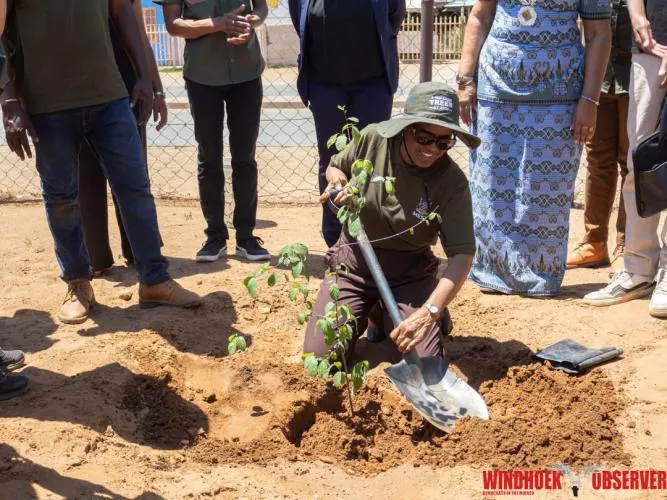
The Namibian government has set ambitious targets to plant and maintain trees as part of its efforts to combat climate change and protect the country's natural vegetation. According to Minister of Environment, Forestry and Tourism Indileni Daniel, the country aims to plant and maintain one million trees by 2030 and two million by 2035. This initiative is part of a proposed national strategy that is currently awaiting final review and Cabinet approval.
The proposed strategy, dubbed the National Strategy on Tree Planting 2026–2035, emphasizes the importance of proper planning, accountability, and sustained care for seedlings after planting. Daniel stressed that planting trees without ensuring their survival would undermine the country's environmental ambitions. The strategy sets a target of at least a 70% survival rate for monitored trees three years after planting, placing emphasis on maintenance rather than simply counting the number of seedlings put into the ground.
The draft strategy outlines several key measures to achieve its targets, including reforestation, growing trees alongside crops, encouraging natural vegetation to recover, and restoring degraded land. It also addresses forest fires and unsustainable wood harvesting, while emphasizing that protecting existing trees is as important as planting new ones. Daniel noted that forests, woodlands, and soils play an important role in storing carbon and supporting the country's climate objectives.
The initiative is linked to Namibia's updated climate commitments for 2026 to 2035 under the Paris Agreement, through the country's Third Nationally Determined Contribution (NDC 3.0). Daniel said that restoring damaged land and protecting woodlands could help communities cope with drought and a changing climate. She also cautioned against planting unsuitable species or trees in areas where they do not naturally belong, saying the strategy would prioritize indigenous and well-adapted species while promoting responsible water use and protecting open ecosystems.
The National Arbor Day commemoration in Rehoboth saw the handover of 500 tree seedlings, with 100 allocated to Kalkrand, 100 to the Hardap Governor's Office, and 300 to Rehoboth. Seven schools also received gardening and tree-planting tools to support practical environmental education. Daniel urged learners to take responsibility for the trees planted in their schoolyards and communities, including arranging for their care during school holidays.
The event also saw support from the private sector, with Swakop Uranium executive vice-president Irvinne Simataa expressing the company's commitment to environmental stewardship. Simataa said the mining company recognizes that its operations affect natural resources and that environmental stewardship has to be integrated into its business practices. He noted that Swakop Uranium has invested in environmental research, biodiversity conservation, and the development of young environmental scientists over the past decade.
Swakop Uranium has invested more than N$6.5 million in community and development initiatives during 2026, including support for gardening and animal projects, the National Plant Genetic Resources Centre, and computer donations to schools in several regions. The company also supports seed collection, germination trials, and the expansion of seedbank storage capacity to help preserve Namibia's plant genetic diversity.
Key points
- The Namibian government aims to plant and maintain one million trees by 2030 and two million by 2035.
- The proposed strategy emphasizes proper planning, accountability, and sustained care for seedlings after planting.
- The initiative is linked to Namibia's updated climate commitments under the Paris Agreement.