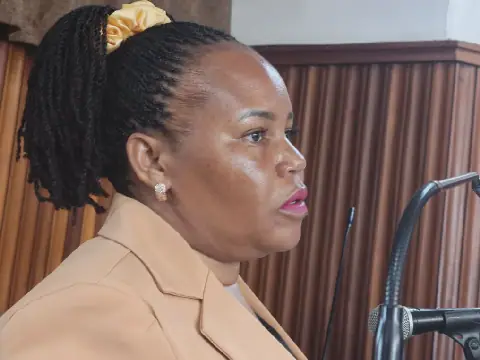
The Bank of Namibia governor, Ebson Uanguta, is set to announce the new repurchase rate for the next three months. Historically, every governor has cited a comprehensive assessment of economic indicators and the need to maintain the peg between the Namibia dollar and the South African rand when making repo rate decisions. This approach has led to a synchronized yet independent movement of interest rates between Namibia and South Africa.
Namibia's current repo rate is 6.75%, and according to the central bank's policy rate logs, the country generally moves its interest rates in the same direction as South Africa. However, the Bank of Namibia does not always make the same changes or act at the same time. The Namibia dollar is pegged to the South African rand, meaning the two currencies have the same value. This unique relationship allows Namibia to make independent monetary policy decisions while maintaining economic stability.
During the Covid-19 pandemic in 2020, both the Bank of Namibia and the South African Reserve Bank cut interest rates sharply to support struggling households and businesses. South Africa's repo rate fell to 3.5%, while Namibia's dropped to 3.75%. The direction of monetary policy changed in 2022 when global inflation started soaring, and both central banks increased interest rates to control inflation. However, the two countries did not raise rates to exactly the same levels.
In 2023, South Africa's repo rate reached 8.25% in May, while Namibia's peaked at 7.75% in June. Namibia maintained its lower rate for over a year before starting to cut rates in 2024, reducing its repo rate to 7.5% in August, a month before South Africa made its first cut in September. The rate-cutting trend continued into 2025, with Namibia's repo rate falling to 6.5% by October and South Africa's rate reaching 6.75% in November.
In 2026, both central banks began raising rates again. Namibia increased its rate to 6.75% in June, while South Africa raised its rate to 7% that month and then to 7.25% in September. The gap between the two countries' repo rates remained between 0.25 and 0.5 percentage points during this period. This difference in interest rates reflects Namibia's independent monetary policy decisions.
In addition to adjusting the repo rate, the central bank took a separate step to reduce borrowing costs in 2025. It narrowed the gap between its repo rate and the prime lending rate from 3.75 to 3.5 percentage points by December. This move aimed to make borrowing more affordable for Namibians and stimulate economic growth.
The repo rate has a direct impact on ordinary Namibians, influencing how much they pay to borrow money. When the repo rate rises, repayments on home loans, vehicle finance, and other loans linked to banks' lending rates may increase. Conversely, when the repo rate falls, borrowing can become cheaper. As the Bank of Namibia announces its new repo rate, Namibians can expect changes in their borrowing costs.
Key points
- The repo rate influences borrowing costs for Namibians.
- Namibia's repo rate is generally aligned with South Africa's but not identical.
- The Bank of Namibia makes independent monetary policy decisions despite the pegged currency.