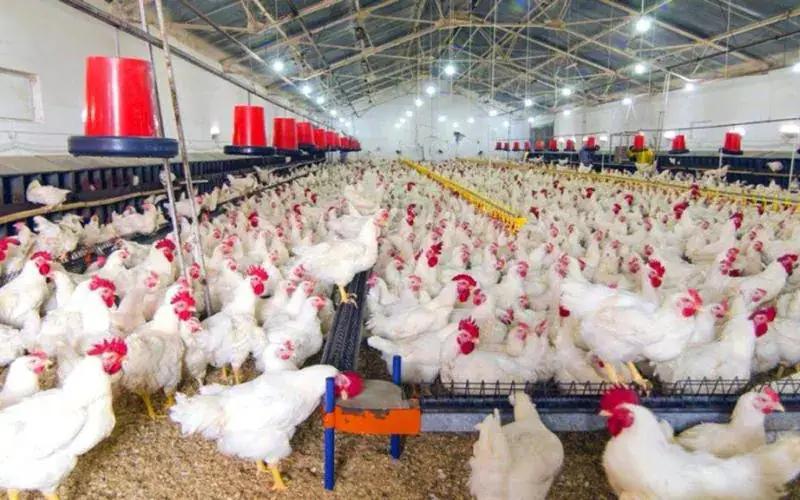
Namibia recorded N$49 million in poultry and poultry-product exports in August 2026, with the majority coming from re-exports. According to the Namibia Statistics Agency (NSA), re-exports made up N$48.9 million of the total export value, while locally produced products accounted for only N$100 000. This significant disparity raises concerns about the value captured by local farmers in Namibia's regional poultry trade.
The NSA reported that imports reached N$53.4 million during the month, resulting in a poultry trade deficit of N$4.4 million. The country's main export destinations for poultry and poultry products were the Democratic Republic of Congo, Zambia, and Botswana. On the other hand, Namibia primarily sourced its imports from Brazil, South Africa, and the United States of America. This highlights the country's reliance on external suppliers to meet its domestic demand.
Despite the challenges, Namibia's local poultry production is not insignificant. The September 2026 Poultry and Dairy Market Watch reported that domestic poultry production increased by 9.16% to approximately 3.65 million kg in August, from 3.35 million kg in July. This growth indicates that Namibian poultry farmers are capable of increasing production, but they face challenges in capturing a greater share of regional export opportunities.
The commercial opportunity for Namibia's poultry industry extends across the value chain, including poultry farming, hatcheries, feed production, veterinary services, slaughtering, processing, packaging, and cold-chain logistics. Strengthening links between poultry farmers and local crop producers could improve input supply and create additional markets for grain farmers. Moreover, investing in modern slaughterhouses and processing facilities could help local businesses meet veterinary and food-safety standards.
To compete with established suppliers from Brazil and South Africa, Namibian businesses must focus on competitive pricing, consistent quality, and reliable supply. Policymakers also have a crucial role to play in providing access to affordable finance, reliable infrastructure, and competitive production inputs. Support measures must consider consumer affordability and the cost of imported inputs to ensure the long-term sustainability of the industry.
The wider merchandise trade figures highlight the economic context in which Namibia's poultry industry operates. The country exported goods worth N$12.7 billion in August, against imports of N$16.6 billion, resulting in an overall trade deficit of N$3.9 billion. While poultry's contribution to this deficit is relatively small, its export composition reveals a broader challenge in terms of domestic productive capacity and value addition.
To turn Namibia's trading position into stronger domestic agricultural value chains, employment, and export earnings, more investment in production, processing, and distribution is necessary. This will enable local businesses to capture a greater share of regional demand and improve their competitiveness in the market. By addressing these challenges, Namibia can unlock the full potential of its poultry industry and create more opportunities for local farmers and businesses.
Key points
- Locally produced poultry products accounted for only N$100 000 of Namibia's total poultry export value of N$49 million in August 2026.
- Namibia's poultry trade deficit was N$4.4 million in August 2026, with imports reaching N$53.4 million.
- The country's poultry industry requires more investment in production, processing, and distribution to capture a greater share of regional demand.
Reporting sources
- How Namibia’s poultry exports are leaving local farmers behind · Windhoek Observer