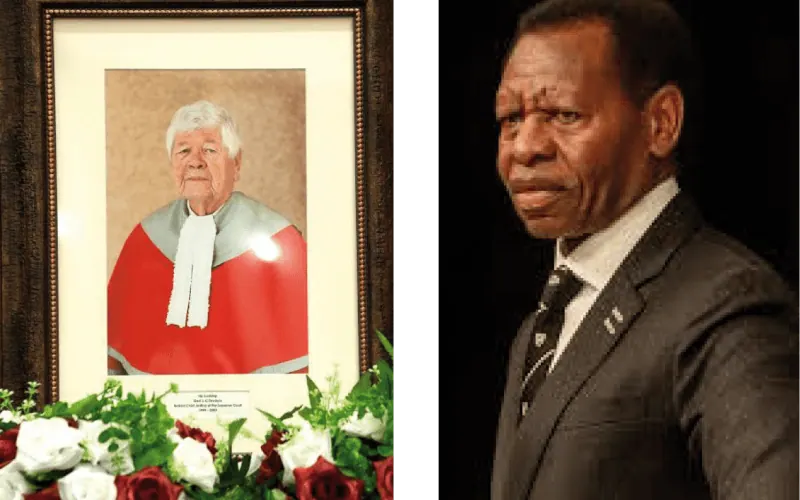
Namibia's legal fraternity has remembered former Chief Justice Emeritus Johan Strydom as one of the key architects of the country's post-independence judiciary. Strydom, who died on 25 September 2026 in Swakopmund at the age of 88, was honoured during a valedictory court session at the Supreme Court in Windhoek. Chief Justice Peter Shivute, the Attorney-General Festus Mbandeka, and members of the Law Society of Namibia reflected on a judicial career spanning almost four decades.
Strydom was born in Otjiwarongo on 17 June 1938 and matriculated at Otjiwarongo High School in 1955. He studied at Stellenbosch University between 1959 and 1963, obtaining BA and LLB degrees. He began his legal career as a prosecutor before practising as an advocate at the Windhoek Bar. He was appointed Senior Counsel in September 1982 and joined the Bench on 1 March 1983.
Shivute said Strydom served as a judge during a difficult period in Namibia's history, when the legal system operated under a framework that was, in many respects, repressive. Yet, he said, Strydom demonstrated judicial independence through decisions that challenged the limits of state power. Among them was a judgment setting aside a certificate issued by the State President that sought to prevent the trial of people accused of killing the late Immanuel Shifidi.
Strydom became Acting Judge-President of the High Court on 23 March 1990, shortly after independence, before his appointment was made permanent in March 1991. He served as Judge-President until 1999, when he became Namibia's third Chief Justice, succeeding Chief Justice Ishmail Mohamed. He served as Chief Justice until June 2003 and continued to serve as an acting judge of the Supreme Court until 2015.
The Attorney-General described Strydom as one of the architects of Namibia's post-independence judiciary and highlighted several judgments that continue to influence the country's legal system. One of the notable cases was Namunjepo and Others v Commanding Officer, Windhoek Prison, in which Strydom dealt with the use of leg chains on incarcerated accused persons.
Strydom's jurisprudence also addressed gender equality and access to justice. In Myburgh v Commercial Bank of Namibia in 2000, the Supreme Court reinforced constitutional equality protections in relation to the common-law concept of marital power. In Government of the Republic of Namibia v Mwilima and Others in 2002, the court dealt with the right to legal representation for indigent accused persons.
Beyond the courtroom, Strydom played a role in building key democratic institutions, chairing the first Electoral Commission of Namibia and the first Delimitation Commission, while also serving as chairperson of the Judicial Service Commission. His legacy serves as a reminder to the legal profession of the importance of the rule of law, judicial independence, integrity, and public service.
Key points
- Johan Strydom played a crucial role in shaping Namibia's post-independence judiciary.
- Strydom's judgments continue to influence the country's legal system, particularly in areas such as dignity, equality, and access to justice.
- He served as a judge for almost four decades, holding various positions, including Chief Justice and Judge-President.