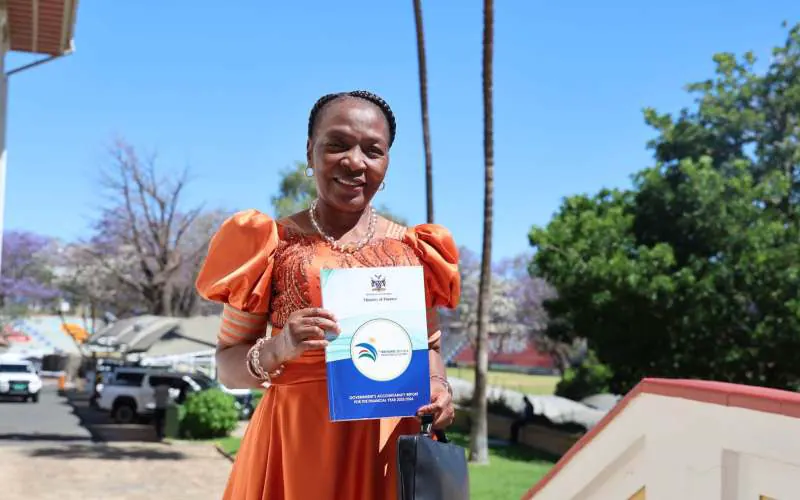
The Namibian government has revised its economic growth forecast for 2026 down to 2.3% from 3.1%, citing slower-than-expected economic performance during the first half of the year. The revised growth forecast is above the 1.7% recorded in 2025. Finance minister Ericah Shafudah announced the revisions in the FY2026/27 Mid-Year Budget Review Statement tabled in the National Assembly on Thursday, 22 October 2026.
The government's revenue forecast for the current financial year has been reduced from N$89.6 billion to N$88.1 billion, mainly due to lower mining receipts, reduced fuel levies, and lower administrative fees. Mining company taxes and royalties have been revised down to N$5.2 billion from N$6.1 billion. Diamond taxes and royalties, which amounted to N$5.8 billion in 2023/24, are projected to fall to N$414 million in 2026/27.
The national budget appropriation has been increased to N$88.6 billion, from the N$87.9 billion announced in February. The additional spending in the midterm budget is due to weaker mining receipts and rising debt-servicing costs putting pressure on public finances. The revised fiscal framework projects a budget deficit of N$16.3 billion, equivalent to 5.5% of gross domestic product (GDP).
The Ministry of Defence has been allocated N$200 million, comprising N$100 million for rations and N$100 million for utilities. The Office of the President will receive N$180 million, including N$140 million for basic sports facilities coordinated by regional governors and N$40 million for security measures. The ministry of urban and rural development will receive N$62 million, including N$50 million for urgent soil erosion mitigation works in Rundu.
An additional N$535 million has been allocated to the Public Service Employees Medical Aid Scheme (PSEMAS), while N$130 million will replenish the Contingency Fund. The government has also allocated N$41 million to the ministry of health and social services to cater for 456 medical and dental interns, and N$26 million to settle outstanding drought relief invoices.
The government is reviewing the zero-rating of value-added tax (VAT) on sugar consumption, a measure originally introduced to provide relief to consumers. The review is informed by concerns about the health effects of sugar consumption. The government is also considering zero-rating import VAT on agricultural inputs and equipment to reduce domestic food production costs.
The National Youth Development Fund has grown to N$317 million, with N$110.2 million disbursed through the Development Bank of Namibia, Agribank, and the Environmental Investment Fund. Subsidised tertiary education introduced at the beginning of the 2026 academic year covers registration and tuition for approximately 87,000 qualifying students at public and private institutions.
Key points
- The Namibian government's economic growth forecast for 2026 has been revised down to 2.3% from 3.1%.
- The national budget appropriation has been increased to N$88.6 billion, from the N$87.9 billion announced in February.
- Diamond taxes and royalties are projected to fall to N$414 million in 2026/27, down from N$5.8 billion in 2023/24.