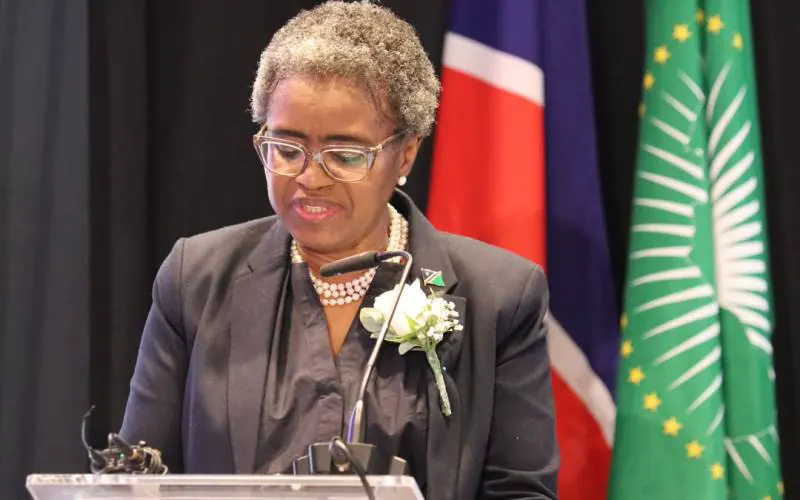
The Namibian government has launched its Third Nationally Determined Contribution (NDC 3.0), outlining an estimated US$14.07 billion, or approximately N$241.52 billion, needed to fund the country's climate ambitions. Environment, forestry and tourism minister Indileni Daniel introduced the plan in Windhoek, emphasizing that Namibia can no longer afford to treat climate action as a long-term policy exercise. Climate change impacts such as droughts, floods, and extreme heat are already being felt by communities.
NDC 3.0 outlines 26 mitigation measures and 106 actions to be implemented by 2035 across various sectors, including energy, agriculture, and forestry. The plan prioritizes adaptation, with nine focus areas and 110 actions covering agriculture, water resources, and infrastructure. Minister Daniel stressed that the plan's success will be measured by its impact on the lives of Namibians. The plan aims to improve livelihoods and address the country's vulnerability to climate change.
The implementation of NDC 3.0 requires approximately US$14.07 billion, with US$6.42 billion allocated for mitigation and US$7.65 billion for adaptation. However, only about 12% of the required funding is unconditional, while the remaining 88% depends on international climate finance and support. Minister Daniel emphasized the need to convert climate priorities into bankable projects that can attract domestic and international investment.
The Namibian government is calling for a whole-of-government and whole-of-society approach to implement the climate plan. Ministries responsible for finance, energy, and agriculture, among others, will have responsibilities under NDC 3.0. Minister Daniel also linked the climate plan to Namibia's natural-resource ambitions, including oil and gas development, emphasizing that climate action and economic development should not be treated as opposing objectives.
The United Nations Development Programme (UNDP) resident representative to Namibia, Amanda Serumaga, echoed the call for implementation, emphasizing that the value of NDC 3.0 will be determined by its practical impact. Serumaga stressed that climate action needs to be translated into tangible benefits for different sectors of society, including water security, productive land for farmers, and efficient energy for businesses.
Serumaga also emphasized the need for climate priorities to be reflected in Namibia's national budget and sector plans. She warned that climate priorities that are not reflected in public expenditure and investment decisions will remain aspirations rather than implementation. The UNDP representative highlighted the importance of accountability in tracking implementation, financing, and results.
Minister Daniel concluded by emphasizing the importance of accountability and results in implementing NDC 3.0. She called on development partners to help mobilize finance, technology, and capacity, and urged the private sector to view NDC 3.0 as an investment and innovation opportunity. The successful implementation of the climate plan will depend on the government's ability to track progress and deliver tangible results.
Key points
- Namibia requires approximately US$14.07 billion to implement its Third Nationally Determined Contribution (NDC 3.0).
- The plan outlines 26 mitigation measures and 106 actions to be implemented by 2035 across various sectors.
- Only about 12% of the required funding for NDC 3.0 is unconditional, while the remaining 88% depends on international climate finance and support.