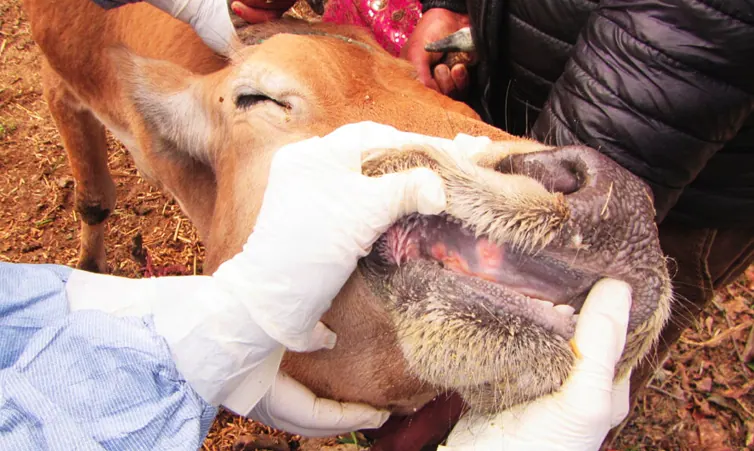
The Namibian government, in collaboration with the livestock industry, began preparations for a potential foot-and-mouth disease (FMD) outbreak in November 2025. This proactive approach included raising funds to mitigate the impact of the disease. By February, Namibia had heightened its alert level due to FMD outbreaks in neighboring countries, enhancing surveillance and preparing farmers for a possible outbreak.
In response to the growing threat, the government, farmers' unions, and the livestock industry launched an FMD Support Fund and National Task Force on 26 February. The fund aimed to raise N$60 million to combat the disease. Additionally, Namibia introduced restrictions on livestock and animal products from parts of Botswana following FMD outbreaks in that country in March.
To reduce the risk of animal diseases crossing the border, the government fast-tracked plans for a 185km veterinary fence along parts of Namibia's border with South Africa between June and July. This measure was part of a broader strategy to protect the country's livestock industry.
On 22 September, FMD was suspected on a commercial farm in the Karasburg area of ||Kharas, with eleven head of cattle showing signs of the disease. Tests conducted on 23 September confirmed that ten of the eleven cattle tested positive for FMD. In response, the government halted the movement and sale of cloven-hoofed animals nationwide, suspending slaughtering, imports, and exports.
Further testing was conducted between 22 and 25 September, with a total of 199 samples collected from the ||Kharas, Khomas, Omaheke, Otjozondjupa, and Oshana regions. Seventeen samples tested positive, all from the Karasburg area. This informed the government's decision to relax some restrictions in areas where no FMD cases had been detected by 27 September.
The relaxation of restrictions allowed for the movement of cooked meat, pasteurised milk, and butter from the northern area to the southern area under normal veterinary rules. However, some restrictions on moving live cloven-hoofed animals across the veterinary cordon fence remained in place. In areas south of the fence, except the ||Kharas region, some livestock movement and slaughtering resumed under strict veterinary controls.
Despite the easing of some restrictions, farm or homestead slaughtering for sale remained prohibited, and the resumption of livestock auctions or international livestock and meat exports was not announced. Products such as cooked and processed meat, pasteurised milk and milk products, and hides processed to the wet-blue stage were allowed to move and trade countrywide.
Key points
- The Namibian government confirmed an FMD outbreak on 23 September and subsequently lifted some restrictions by 27 September.
- A 185km veterinary fence is being constructed along Namibia's border with South Africa to prevent animal diseases.
- The movement of certain products, including cooked meat and pasteurised milk, has been allowed to resume nationwide.