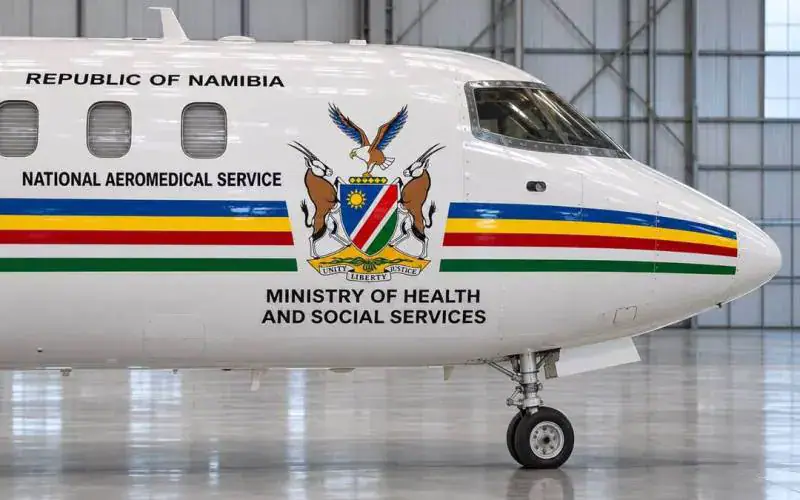
Namibia's health minister, Esperance Luvindao, has clarified that the country's newly launched state-owned air ambulance service will not be available to every patient. The service, launched in Windhoek, aims to improve access to emergency medical care for patients in remote communities. Luvindao stated that access to the service will be determined by the severity of medical conditions and whether road transportation poses a clinical risk.
The air ambulance service will specifically target patients whose clinical conditions and transfer circumstances justify aeromedical transportation. These include patients requiring urgent specialist interventions unavailable at referring hospitals, where ground transportation is not clinically appropriate. Critically ill or injured patients for whom road transfers would create unacceptable clinical risks or delays will also be considered.
Other qualifying cases include patients requiring time-critical neurosurgical, cardiac, trauma, and obstetric care, as well as those needing specialised monitoring and retrieval capabilities available through the aeromedical team. To manage access to the service, the ministry has repurposed and activated an emergency call centre that will serve as the central coordination, communication, referral verification, and dispatch point.
The centre will assess requests for aeromedical services to ensure that patients with justified medical needs are evacuated and transferred promptly. The minister said the air ambulance would form part of the ministry's broader plans to strengthen emergency medical services, including better coordination of emergency teams and ensuring that ambulances across the country remain operational.
The ministry ultimately aims to establish a dedicated directorate responsible for coordinating emergency services, standardising operations, and addressing challenges such as non-functional ambulances at hospitals. Vice President Lucia Witbooi, who officially inaugurated the service, said the initiative was aimed at reducing the impact of Namibia's vast geography and long distances between remote communities and referral hospitals on access to emergency healthcare.
The service includes a Learjet 31A configured as an air ambulance, which Witbooi described as an intensive care unit in the sky. It will also include helicopter evacuation services through strategic collaboration with the Namibian Police Force (NamPol) and the Namibia Defence Force (NDF) to respond to localised emergencies where necessary.
The Namibia Civil Aviation Authority (NCAA) began a five-phase certification process in February 2026 to approve the first state-owned air ambulance service. The authority will continue monitoring the service through regulatory oversight, surveillance, and periodic inspections to ensure compliance with aviation safety requirements.
Key points
- Patients must have severe medical conditions or be at clinical risk to qualify for the air ambulance service.
- The service aims to reduce the impact of Namibia's vast geography on access to emergency healthcare.
- The initiative's success will depend on sustained funding, aircraft maintenance, and personnel training.