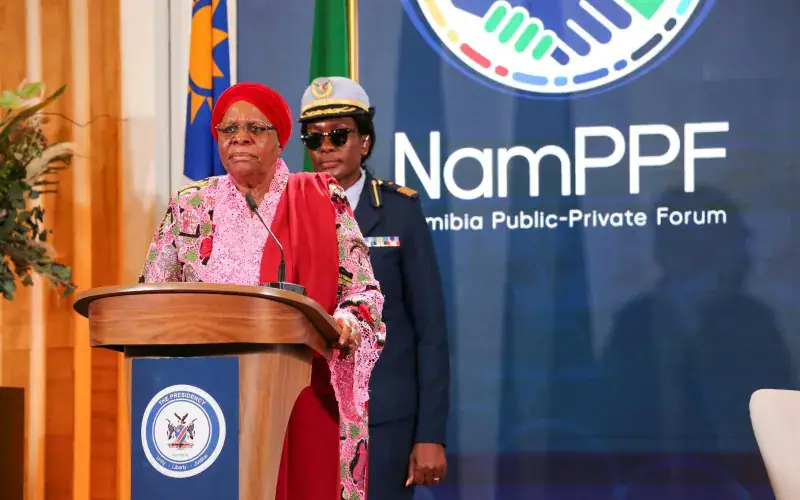
The Namibian government has introduced significant investment reforms aimed at attracting foreign capital and accelerating private-sector growth. A five-year Employment Permit for Conducting Business was gazetted in July and took effect in September, allowing qualifying investors to obtain authorisation for up to five years. This move is part of a broader effort to improve investor confidence, reduce administrative delays, and make the country more competitive. The reforms also include the Investment Promotion and Facilitation Bill, tabled in Parliament on 4 November.
President Netumbo Nandi-Ndaitwah has emphasised the need for implementation, calling on the government and business to move beyond policy discussions. She highlighted the importance of local value addition, technology transfer, skills development, and participation by Namibian businesses in supply chains. The President's direct engagement with investors at State House is also part of the administration's efforts to attract capital and address obstacles affecting major projects. Her remarks reflect the government's ambition to balance investor attraction with opportunities for domestic businesses.
The investment reforms have sparked debate over how much of the resulting investment should benefit local businesses, workers, and communities. Minister of International Relations and Trade Selma Ashipala-Musavyi stated that a strong investment environment must support both investors and local enterprises. The government's position is that foreign capital should complement domestic businesses, rather than displacing them. This challenge is central to the Namibia Public-Private Sector Forum in Windhoek, which focuses on accelerating investment, public-private partnerships, and job creation.
Namibia has attracted significant investment in recent years, with foreign direct investment increasing from N$50.5 billion between 2009 and 2020 to N$140 billion between 2021 and 2025. The country's exports also grew from N$68 billion in 2020 to N$125 billion in 2025. However, unemployment remains a pressing issue, with a rate of 36.9% and youth unemployment at 44.1%. The International Labour Organization (ILO) reported that 57.7% of the workforce is in informal employment.
The UN Resident Coordinator, Hopolang Phororo, emphasised the need to convert investment potential into productive businesses and jobs. Namibia Employers' Federation Secretary-General Helene Ochs called for investment that supports economic diversification, competitiveness, and decent work. The government faces the challenge of balancing investor attraction with local participation requirements, ensuring that foreign recruitment does not displace qualified Namibian workers.
The investment incentives and extended business permits have attracted criticism from some quarters, including NUDO member of parliament Vetaruhe Kandorozu. He questioned the granting of work permits to foreign nationals, particularly in managerial positions, and called for debate on employment practices in the mining and transport industries. Kandorozu's concerns reflect a wider debate over immigration, employment, and local opportunities.
The proposed investment framework faces scrutiny from various stakeholders, including the Economic Policy Research Association and Senior Advocate Raymond Heathcote. The International Monetary Fund's 2026 Article IV assessment identified regulatory delays as a constraint on private investment, highlighting the importance of predictable regulations for businesses considering long-term investment. The government must ensure that investment incentives produce measurable returns for Namibia, balancing investor attraction with local participation requirements.
Key points
- The Namibian government introduces a five-year Employment Permit for Conducting Business to attract foreign capital and accelerate private-sector growth.
- The investment reforms aim to balance investor attraction with opportunities for domestic businesses and workers.
- The government faces challenges in translating investment growth into broad-based employment and productive domestic enterprises.
Reporting sources
- Namibia courts investors, but what do citizens gain? · Windhoek Observer