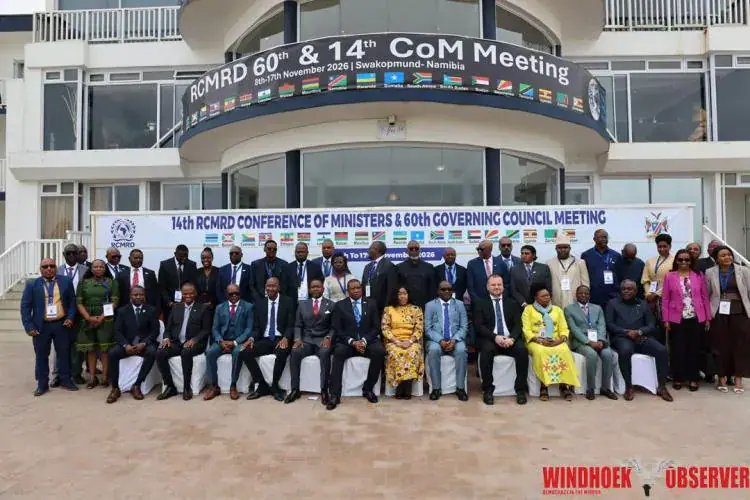
President Netumbo Nandi-Ndaitwah has called on regional ministers to move beyond policy discussions and focus on practical, time-bound commitments that deliver tangible benefits to people across Eastern and Southern Africa. The call was made through a message delivered by Minister of Agriculture, Fisheries, Water and Land Reform Inge Zaamwani at the 14th Conference of Ministers of the Regional Centre for Mapping of Resources for Development (RCMRD) in Swakopmund. Nandi-Ndaitwah emphasized the need for actionable resolutions, strengthened institutional cooperation, and prioritized programs that address the region's development needs.
The conference, which is the centre's highest policy organ, aims to provide strategic direction for its work. Zaamwani highlighted the importance of reliable surveying, mapping, remote sensing, and geographical information systems in informing evidence-based decisions and accelerating sustainable development. She questioned the practice of settling people in areas without adequate water resources, stressing the need for accurate information about available resources before making development decisions. This approach, she noted, would help prevent situations where people are settled in areas without access to basic necessities like water.
Erongo Regional Council Chairperson Lazarus Kanelombe emphasized the critical role of reliable geospatial information in land administration, agricultural planning, infrastructure development, water-resource management, and disaster-risk reduction. He noted that Eastern and Southern African countries face shared challenges, including food and water security and natural-resource management, which require collective action. Kanelombe called on ministers to support initiatives that strengthen the RCMRD's institutional capacity, financial sustainability, and service delivery to member states.
Zambia's Minister of Lands, Patrick Mucheleka, who served as the outgoing chairperson of the RCMRD Conference of Ministers, reported progress in efforts to strengthen the organisation's financial capacity. He noted that several member states had made progress in meeting their financial obligations, but expanding the centre's membership remained a priority. Mucheleka identified Mozambique, Angola, Eritrea, the Democratic Republic of Congo, Djibouti, and Madagascar as countries the organisation hopes to bring on board before the next Conference of Ministers in two years.
André Nonguierma, Chief of the Geospatial Information Management Section at the United Nations Economic Commission for Africa, emphasized the need for African countries to strengthen their ability to generate and manage their own geospatial information. He noted that the RCMRD, established in 1975, has grown to serve over 20 member states across Eastern and Southern Africa. Nonguierma stressed that the value of geospatial technology should be measured by its impact on people's lives, citing its applications in agriculture, urban planning, and disaster management.
Nonguierma cautioned that technological advances, including artificial intelligence and satellite technology, would not automatically improve development without investment in institutions and people. He urged governments to strengthen national geospatial data systems, establish common standards, and improve coordination between institutions. By connecting geographical information with national statistics and administrative data, governments can identify development inequalities and determine which communities are being left behind.
The RCMRD was established under the auspices of the United Nations Economic Commission for Africa and serves member states across Eastern and Southern Africa. Namibia joined the organisation on 10 April 1997. The biennial Conference of Ministers provides a platform for member states to discuss regional development challenges and opportunities, and to chart a course for sustainable development through the effective use of geospatial technologies.
Key points
- President Netumbo Nandi-Ndaitwah calls for practical commitments to deliver tangible benefits to people across Eastern and Southern Africa.
- The 14th Conference of Ministers of RCMRD aims to provide strategic direction for the centre's work.
- André Nonguierma emphasizes the need for African countries to generate and manage their own geospatial information.
Reporting sources
- ‘Move beyond policy discussions,’ NNN tells ministers · Windhoek Observer