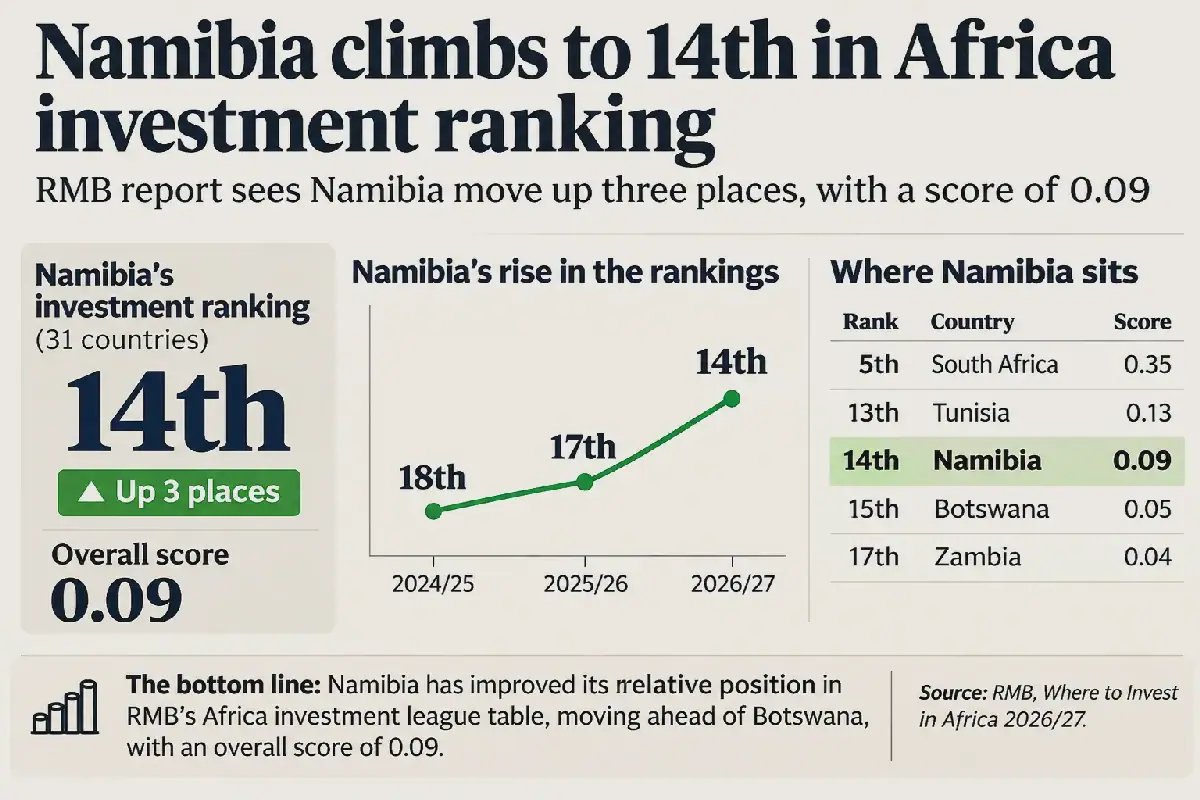
Namibia has improved its ranking in the latest RMB Where to Invest in Africa report, climbing three places to 14th out of 31 African countries. This is an improvement from its 17th position last year and 18th in 2024/25. The country's score of 0.09 is slightly better than Botswana's 0.05, which fell two places to 15th. However, the small difference in scores highlights the tight grouping of economies in the middle of the ranking.
The RMB report assesses investment attractiveness using 20 indicators covering areas such as economic growth, governance, financial development, employment, and human development. Namibia's performance is supported by strong scores in political stability, personal freedom, and international connectedness. These factors contribute significantly to its overall score, with political stability contributing 0.08, personal freedom 0.07, and connectedness 0.06.
Despite these strengths, Namibia faces challenges that weigh on its investment appeal. Income inequality is the largest negative contributor, at minus 0.10, while the country's GDP growth forecast and population size each contributed minus 0.06. Unemployment and GDP also had negative contributions of minus 0.05 each. These findings highlight the persistent challenges Namibia faces in improving its investment attractiveness.
The report introduces a separate framework examining economic resilience and vulnerability. Namibia ranks fourth on the Economic Resilience Index, behind Mauritius, Seychelles, and Botswana, with a score of 0.62. Its strongest resilience pillars are good governance, market efficiency, and environmental management, with scores of 1.27, 0.91, and 0.84, respectively.
However, Namibia's social development score is only marginally above the group average, at 0.10, while its macroeconomic stability score is broadly in line with the average, at minus 0.02. The Economic Vulnerability Index gives Namibia a score of 0.08, indicating slightly greater vulnerability than the group average. Strategic import dependence and trade openness are areas of exposure, with scores of 0.47 and 0.40, respectively.
RMB places Namibia in its “Rift Walls” category, describing economies with relatively high resilience but significant structural vulnerability. The country's export-concentration score and climate and geographical exposure score are below the group average. The report suggests that Namibia's institutional and policy strengths may help it withstand external shocks, but structural constraints remain.
The findings of the report need to be interpreted in context, as the ranking measures Namibia's position relative to other African economies across a set of indicators. It is not a direct measure of the country's current economic growth or proof that domestic investment conditions have improved by the same margin as its ranking. The report provides valuable insights into Namibia's investment attractiveness and areas for improvement.
Key points
- Namibia ranks 14th in RMB's Where to Invest in Africa report, despite challenges from income inequality and unemployment.
- The country's strong institutions and policy strengths support its investment proposition, but a relatively small economy and employment constraints remain obstacles.
- Namibia is placed in the “Rift Walls” category, describing economies with high resilience but significant structural vulnerability.