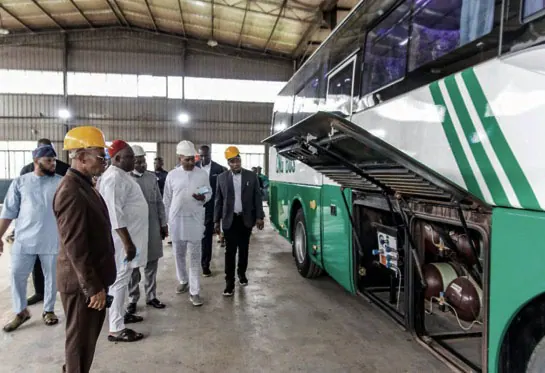
The National Automotive Design and Development Council (NADDC) and its Governing Board have embarked on a nationwide tour of auto manufacturing and assembly facilities. The tour, which began in Lagos, moved eastward to Anambra State, where the team visited Innoson Vehicle Manufacturing Company Ltd (IVM) in Nnewi and Kojo Motors in Umunya. Led by the Chairman of the NADDC Governing Board, Chief Emma Eneukwu, and the Council's Director General/Chief Executive Officer, Otunba Oluwemimo Joseph Osanipin, the team assessed the operations, technical capabilities, and production capacities of the facilities.
During the visit, Chief Eneukwu expressed his satisfaction with the level of investment and technical development at the facilities. He stated that the visit aimed to provide Board members with first-hand information about the technical know-how, production capacity, and challenges confronting local vehicle manufacturers. The Chairman emphasized the need for a strong automotive industry law to empower the Council to regulate the sector, address the influx of used and substandard vehicles, protect local manufacturers, and create an enabling environment for locally produced vehicles to compete favorably in the market.
Chief Eneukwu commended the Federal Government, under President Bola Ahmed Tinubu, for its support towards the development of Nigeria's automotive industry. He noted that greater emphasis must be placed on local content, technology transfer, and skills development to enable Nigerians to acquire the technical expertise required to manufacture vehicles locally. The Chairman's comments highlight the importance of government support and investment in the sector to drive growth and development.
Otunba Oluwemimo Joseph Osanipin stated that the tour was organized to enable the Governing Board and Management to understand the operations, capabilities, and development needs of vehicle assemblers and manufacturers across the country. He expressed delight at the scale of investment witnessed at Innoson Vehicle Manufacturing, particularly its production of commercial buses and mass-transit vehicles, as well as its processes for building vehicles from the chassis stage.
The NADDC Director-General commended Innoson's investment in a new facility dedicated to the manufacture of electric vehicles (EVs) and Compressed Natural Gas (CNG) vehicles, including heavy-duty trucks. This investment aligns with the Federal Government's drive to promote cleaner and more affordable energy and reduce environmental impact. Osanipin assured local manufacturers of NADDC's continued support in strengthening local content, technology development, and the sustainable growth of Nigeria's automotive industry.
Chief Innocent Chukwuma, Chairman and Chief Executive Officer of Innoson Vehicle Manufacturing, highlighted the importance of transitioning to CNG and electric vehicles to address high fuel costs and promote sustainable transportation. He commended the Federal Government's investment in CNG infrastructure and called for a review of policies, including vehicle import duty concessions, which he said places local manufacturers at a disadvantage. Supporting local manufacturing, he argued, would create employment opportunities, strengthen the economy, and ensure that investments in the sector deliver wider benefits to Nigerians.
The NADDC team also visited Kojo Motors' assembly facility in Umunya, where the Executive Director, Mr. Chinedu Oguegbu, disclosed that the company had operated in the automotive industry for over 30 years and had built partnerships with Original Equipment Manufacturers (OEMs) globally. The company's partnership with Yutong, a leading vehicle manufacturer, had enabled it to assemble the manufacturer's products in Nigeria, while the OMAA, a Nigerian brand, was being produced with the ambition of reaching international markets. The visit demonstrates NADDC's commitment to engaging with local manufacturers and understanding their needs and challenges.
Key points
- The NADDC tour aims to assess the operations and capabilities of local vehicle manufacturers and identify areas requiring support.
- The Council's leadership emphasized the need for a strong automotive industry law to regulate the sector and protect local manufacturers.
- Local manufacturers called for a review of policies, including vehicle import duty concessions, to create a level playing field for domestic production.