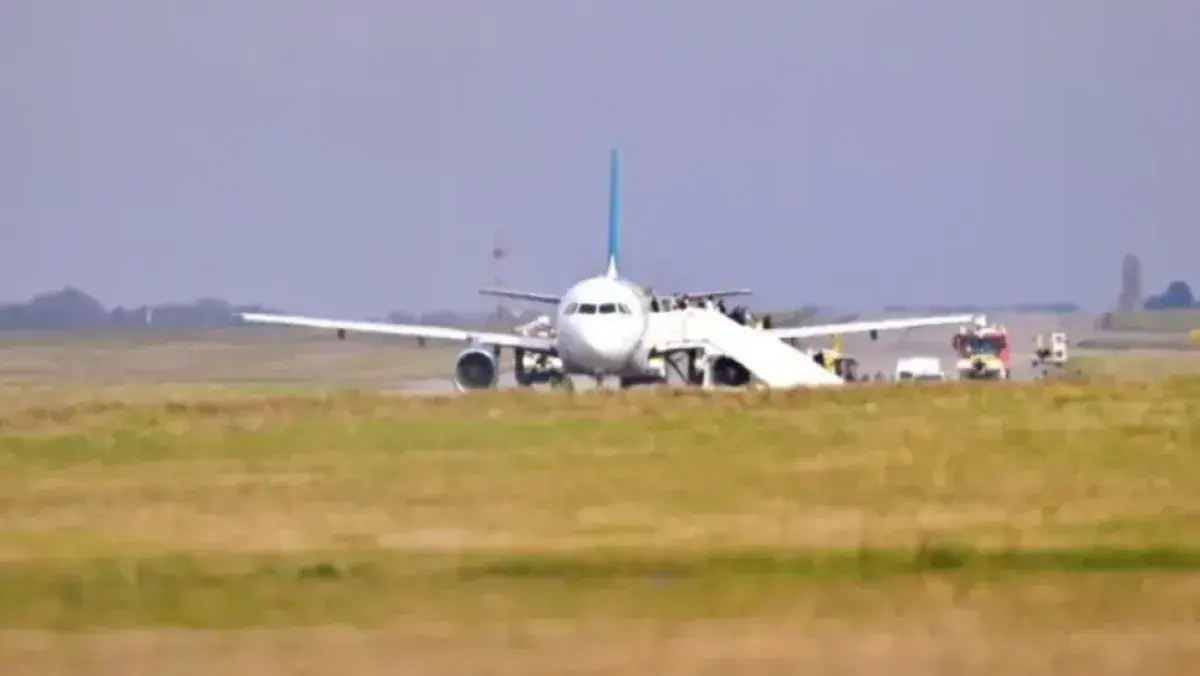
On Thursday, several European airports and airlines reported receiving bomb threats, prompting fighter jets to escort civilian planes and leading to emergency landings. At least 20 flights were affected across Europe, with most threats targeting low-cost carriers. The threats, which were later deemed false, affected flights to and from countries including Bulgaria, Czech Republic, Italy, and Greece.
The threats were made to flights operated by companies such as Ryanair, Wizz Air, and Fin Air. A Fin Air flight from Helsinki to Rome was escorted by an Italian fighter jet, while a Wizz Air flight from Milan to Warsaw was diverted to Vienna. The threats were made via email, with one message claiming to be from a group calling itself "Fighters for the Male State," which appears to be linked to a Russian nationalist movement.
In Italy, a flight from Dublin to Rome was diverted to a French airbase after receiving a bomb threat. The flight, operated by an A320 aircraft, was escorted by French military jets. The Italian authorities reported that the threat was made via email, with the message claiming that explosives were on board. The flight landed safely, and no explosives were found.
The Czech police reported that four flights to Prague, operated by Ryanair, EasyJet, and Sky Express, received bomb threats. However, the police considered the threats to be of low credibility and took necessary security precautions. In Denmark, two flights that received threats landed safely in Copenhagen, with police stating that there was no risk to passengers or airport personnel.
In Greece, two flights operated by Aegean Airlines received "baseless" threats. The flights, one from Thessaloniki to Milan and the other from Athens to Vienna, were not affected. Spanish airport operator Aena reported that three flights to Madrid received threats, but did not disclose the airlines or flight details.
According to Eurocontrol, the disruptions represented a small fraction of the 25,072 flights scheduled to take place across Europe on Thursday. The threats did not appear to be linked to any specific group or individual, with authorities continuing to investigate the source of the threats.
The incidents highlight the ongoing security concerns facing European airports and airlines. Authorities have taken steps to increase security measures, including increasing screening and surveillance. The investigation into the threats is ongoing, with authorities working to identify the source and motivations behind the incidents.
Key points
- Multiple European flights received bomb threats on Thursday, leading to fighter jet escorts and emergency landings.
- The threats, which were later deemed false, targeted low-cost carriers and flights to and from several European countries.
- Authorities continue to investigate the source and motivations behind the incidents, with security measures being increased at European airports.