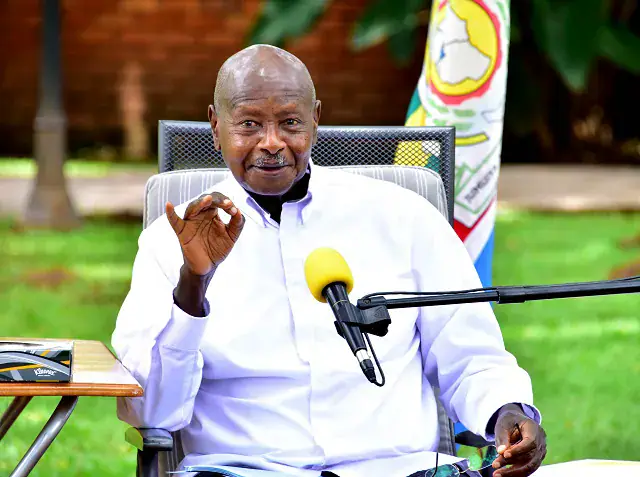
Ugandan President Yoweri Museveni has cautioned judges in the East African Community (EAC) against issuing court orders that obstruct government infrastructure projects. In a speech delivered by Uganda's First Deputy Prime Minister and Minister for East African Community Affairs, Rebecca Alitwala Kadaga, at the East African Court of Justice's (EACJ) 25th anniversary celebrations in Arusha, Tanzania, Museveni criticized what he termed 'ideological disorientation' among some judges. He accused them of applying European legal precedents without considering the economic realities of developing countries.
Museveni cited cases where courts issue injunctions to stop the construction of roads, railways, and hydroelectric dams over 'minor procedural issues.' He argued that such decisions undermine projects intended to improve people's livelihoods. The Ugandan leader described these actions as 'sabotage' of the region's future, emphasizing that justice should not delay infrastructure development or protect smugglers.
The EACJ Judge President, Nestor Kayobera, stressed that judicial independence, impartiality, and integrity must remain central to the Court's work. He reaffirmed the importance of upholding the Treaty as the region pursues economic integration. Kayobera noted that the Court, through its jurisprudence, has helped clarify the obligations of Partner States and advance legality, accountability, and good governance within the Community.
EAC Secretary-General Stephen Patrick Mbundi reported that the Court has registered 1,032 cases as of August 2026, reflecting the growing recognition of its role in resolving disputes arising under the Treaty. He emphasized that the Court's decisions have contributed to interpreting Treaty provisions, clarifying institutional responsibilities, and strengthening the principles underpinning regional integration.
Mbundi also highlighted the need for increased investment in the Court's judicial, financial, and human resource capacity, particularly with the expansion of the EAC from three founding members to eight Partner States. He called for investment in digital infrastructure to improve case management and speed up the handling of disputes.
The anniversary celebrations, held under the theme "25 Years of the East African Court of Justice: From Foundation to Future," brought together regional judges, government officials, and legal practitioners to reflect on the Court's contribution to regional integration and its future role. Museveni urged the EACJ to focus on protecting the Bloc's Treaty and ensuring that member states honor their commitments to regional trade and economic integration.
The Ugandan leader described the Court as essential to building investor confidence, saying businesses need predictable and impartial mechanisms to resolve disputes involving member states. He emphasized that the law should be an instrument of social transformation and economic liberation, not a suicide pact.
Key points
- Museveni criticizes EAC judges for 'ideological disorientation' and applying European legal precedents without considering the economic realities of developing countries.
- The EACJ has registered 1,032 cases as of August 2026, reflecting its growing role in resolving disputes arising under the Treaty.
- Museveni urges the EACJ to focus on protecting the Bloc's Treaty and ensuring that member states honor their commitments to regional trade and economic integration.
Reporting sources
- Museveni warns EAC judges against rulings that obstruct development · sudanspost.com