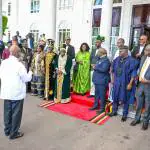
President Yoweri Museveni has urged cultural leaders in Uganda to refrain from engaging in politics and instead focus on preserving the country's cultural heritage. He made these remarks at the opening of a two-day Cultural Leaders Conference at State House, Entebbe, where he addressed kings and other cultural leaders from across the nation. Museveni emphasized that elected leaders should handle policy-making, legislation, and public administration, while cultural leaders concentrate on guiding their communities.
Museveni highlighted the differences in accountability between elected officials and cultural leaders, whose positions are largely hereditary. He noted that voters can hold elected leaders accountable and remove them from office if they fail to perform, whereas cultural leaders are not subject to the same level of accountability. As a result, Museveni argued that cultural leaders should not seek to exercise political authority, allowing them to maintain their roles as custodians of cultural heritage.
The President used the analogy of parents and grown-up children to describe the relationship between cultural leaders and their subjects. He stated that just as parents should allow their grown-up children to manage their own affairs, cultural leaders should permit communities to govern themselves and offer advice only when requested. This approach, Museveni believes, will enable cultural leaders to maintain their influence while allowing elected leaders to handle governance.
Museveni also reflected on Uganda's political history, particularly the abolition of traditional kingdoms under former President Milton Obote in 1967. He expressed disagreement with Obote's approach, which involved initially appearing to support federalism before using force to abolish the institutions. In contrast, Museveni praised former Democratic Party leader Benedicto Kiwanuka for openly communicating the limits of what the kingdoms could demand within a united Uganda.
The President emphasized that traditional institutions can continue to exist without controlling government functions, provided they withdraw from policy formulation, legislation, administration, and adjudication. He believes that this separation is necessary to prevent cultural institutions from obstructing Uganda's political and development journey. Museveni also urged cultural leaders to promote national unity and Pan-Africanism, arguing that tribal chauvinism and limited integration have weakened indigenous societies.
In a message posted on his official X account after the meeting, Museveni highlighted the importance of cultural institutions in preserving Uganda's indigenous knowledge, languages, and skills, collectively referred to as Emyooga. He encouraged cultural leaders to promote patriotism and broader African integration while preserving cultural heritage. Additionally, Museveni challenged cultural leaders to reject what he described as a colonial mentality that makes Africans despise their own heritage.
The conference, which runs from November 4 to 5, brings together traditional leaders to discuss how cultural institutions can promote national unity, preserve Uganda's heritage, and contribute to development. The meeting takes place against the backdrop of Uganda's constitutional framework, which recognizes traditional and cultural institutions but does not permit their leaders to exercise executive, legislative, or administrative powers of government.
Key points
- Cultural leaders should focus on preserving heritage, not policy-making.
- Elected leaders should handle governance, while cultural leaders guide communities.
- Traditional institutions should complement elected government structures, not compete with them.