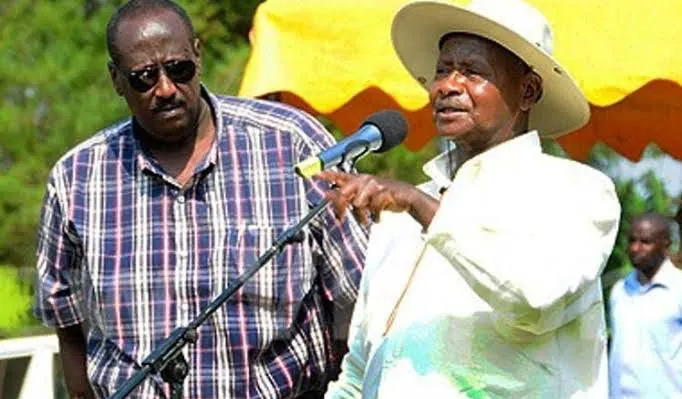
In a shocking move, President Yoweri Museveni has relieved General Salim Saleh of his duties, citing concerns over the general's alleged involvement in the sale of illegal firearms. General Saleh, who had previously served as Senior Presidential Advisor on Defence and Security, had apparently fallen out of favor with the President. The exact nature of the allegations against him remains unclear, but sources close to the President's office suggest that they are serious enough to warrant his removal from office.
General Saleh recently opened up about his past financial struggles, revealing that he had faced bankruptcy nearly two decades ago. In 2003, he approached President Museveni for help in resolving his debts, which had spiraled out of control due to his own "reckless" handling of money. The General admitted to having made poor investments, including lending to individuals who subsequently defaulted on their loans. This led to a significant erosion of his wealth, leaving him on the brink of financial ruin.
At the time, General Saleh sought a way back into military service, believing that a return to the army was the only solution to his financial woes. However, President Museveni was reportedly unmoved by his brother's pleas, viewing his financial state as a security risk. The President allegedly warned General Saleh that his financial situation made him susceptible to engaging in illicit activities, such as selling guns. This warning was apparently made in 2003, when General Saleh approached the President for assistance.
President Museveni's concerns about General Saleh's financial situation were apparently not unfounded. The General's business ventures, including those linked to Uganda Commercial Bank (UCB) and the Coffee Marketing Board, had collapsed due to his personal "mistakes." Despite this, the President advised General Saleh to liquidate his assets to settle his debts, rather than offering him a military posting. However, he did instruct him to retain the land in Kapeeka, which was earmarked for a future industrial park project.
The Kapeeka Industrial Park has since been developed, and it has become a successful venture. However, it appears that President Museveni's trust in General Saleh has been irreparably damaged. The General's removal from office has sent shockwaves through Uganda's military and political establishments, with many left wondering about the implications of this move. General Saleh's future plans remain unclear, but it is evident that he will no longer play a role in the President's office.
The allegations against General Saleh are serious, and it remains to be seen whether they will lead to any formal charges or prosecution. What is clear, however, is that President Museveni takes issues of national security extremely seriously, and he will not hesitate to take action against anyone suspected of compromising the country's stability. General Saleh's removal from office serves as a testament to this commitment.
As the situation continues to unfold, many in Uganda are left questioning the circumstances surrounding General Saleh's removal from office. While the exact nature of the allegations against him remains unclear, it is evident that President Museveni's decision was motivated by a desire to protect the country's security and stability. The incident has highlighted the challenges of balancing personal relationships with the demands of national security, and it remains to be seen how this will impact Uganda's politics in the future.
Key points
- President Museveni sacked General Salim Saleh due to allegations of selling illegal guns.
- General Saleh had previously faced financial difficulties and had sought help from President Museveni in 2003.
- The incident has raised questions about the implications of General Saleh's removal from office for Uganda's military and political establishments.