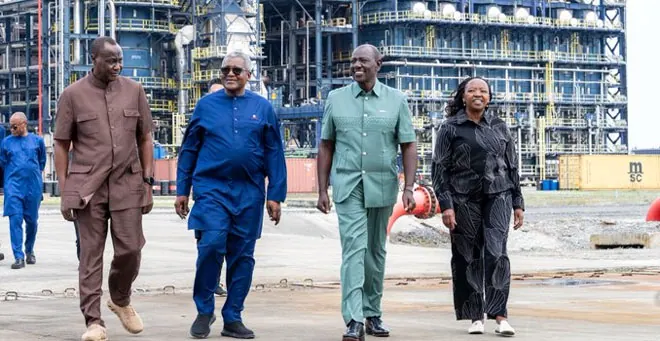
The construction of the Dangote East Africa Refinery in Lamu, Kenya, is set to revolutionize the region by creating a massive hub for engineering talent and industrial employment. The project, led by Dangote Group Chairman Aliko Dangote, aims to generate at least 60,000 jobs, with a focus on hiring, training, and retaining local engineers and technical professionals. This strategic move is expected to reverse Africa's brain drain and ensure that local hands build the continent's energy future.
The groundbreaking ceremony was attended by three African heads of state, including Kenyan President William Ruto, who hosted the event, as well as Yoweri Museveni of Uganda and Abiy Ahmed of Ethiopia. West African dignitaries Romuald Wadagni of Benin and Jean-Lucien Savi de Tové of Togo also joined the ceremony, demonstrating an unprecedented wave of pan-African support for the venture. The $16 billion facility represents the Dangote Group's largest energy investment outside of Nigeria.
Aliko Dangote revealed that the strategic choice of location for the refinery was due to Lamu's geopolitical and logistical positioning, making it the ideal gateway to unify and serve the entire East African energy market. The facility will directly supply refined petroleum products to an expansive market encompassing Kenya, Ethiopia, South Sudan, Uganda, Tanzania, Rwanda, Burundi, and the Democratic Republic of Congo. By daily producing over 100 million litres of petrol, diesel, and aviation fuel, the project aims to permanently eliminate East Africa's heavy reliance on imported foreign fuels.
The human capital model for the project draws inspiration from the lessons learned during the development of Dangote's flagship refinery complex in Lekki, Lagos State, Nigeria. During the construction of the Lagos plant, the Dangote Group faced a massive challenge of a domestic technical skill shortage, initially forcing them to rely heavily on foreign technicians and specialized expatriates. To avoid repeating this dynamic in East Africa, Dangote is prioritizing localized capacity-building from day one.
The Lamu project will utilize intensive training programs to upskill local Kenyan and East African engineers, preparing them to manage complex petroleum infrastructure. Dangote emphasized that the refinery serves as a gate; once operational, the highly skilled technical workforce it produces will naturally attract countless other secondary industries and manufacturing investments into the country. President Ruto, who personally toured the Lagos refinery on September 25, strongly defended the project against recent local friction and legal pushback.
Addressing local land protests and a recent court order seeking to freeze progress on disputed land, President Ruto maintained that the investment is far too critical for the nation's future to be derailed. He noted that the refinery will fundamentally secure fuel reliability, stabilize pump prices, and anchor the country's long-term industrialization goals. Heavy logistical preparations are already underway to support this mandate, with the Kenya Ports Authority confirming that the Port of Lamu has already received nearly 3,000 metric tonnes of specialized construction equipment.
The facility is designed to connect directly to deep-water crude supplies using 120 kilometres of subsea cables to seamlessly transport raw oil from ocean vessels straight to the refining units. By integrating modern engineering practices with a steadfast commitment to regional integration, the Dangote East Africa Refinery is positioned to rewrite the economic narrative of the bloc. For thousands of young African engineers and technical graduates, the Lamu project represents more than just an industrial plant; it is a historic opportunity to gain world-class expertise, build regional self-sufficiency, and establish Africa as a global powerhouse in energy independence.
Key points
- The Dangote East Africa Refinery aims to generate at least 60,000 jobs and transform the region into a massive hub for engineering talent and industrial employment.
- The $16 billion facility will directly supply refined petroleum products to an expansive market encompassing eight countries in East Africa.
- The project prioritizes localized capacity-building, with intensive training programs to upskill local Kenyan and East African engineers.