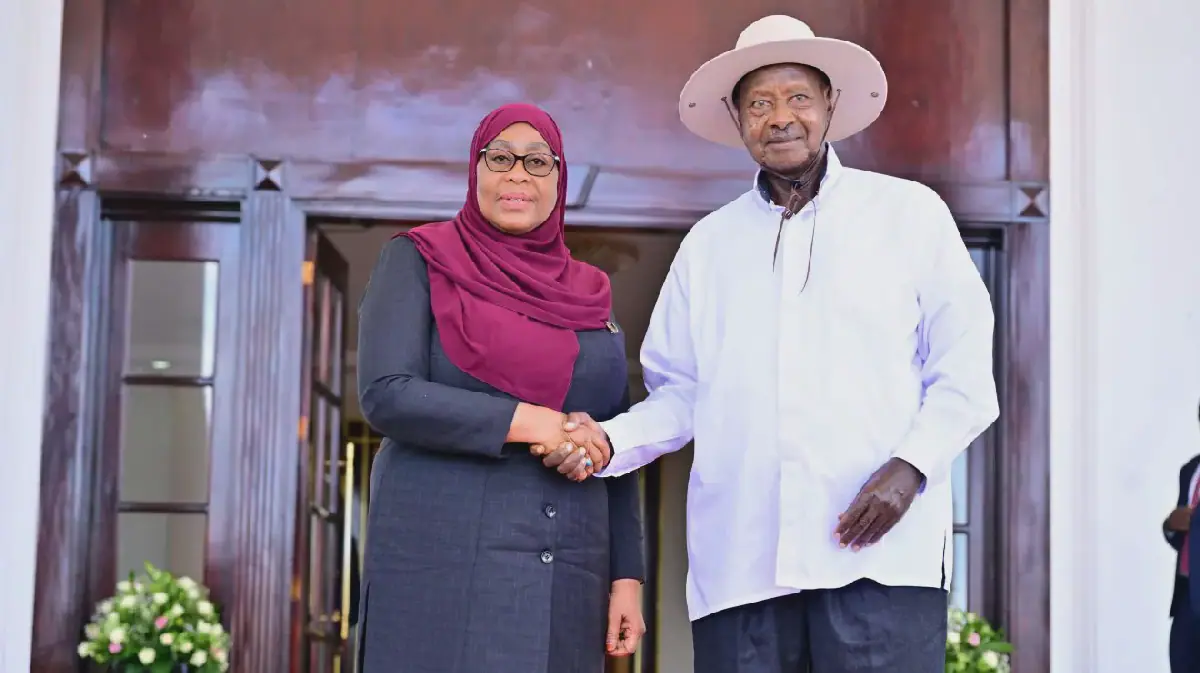
Uganda's President Yoweri Museveni and Tanzanian President Dr Samia Suluhu Hassan have committed to expediting the completion of the East African Crude Oil Pipeline (EACOP) and accelerating the development of the Standard Gauge Railway (SGR). The two leaders held bilateral talks at State House Entebbe, focusing on strengthening cross-border connectivity, expanding market access, and facilitating the movement of goods and people. This meeting aimed to unlock shared prosperity between the two nations.
The EACOP project is currently 93.9% complete, according to Museveni. The 1,443-kilometre pipeline will transport Uganda's waxy crude oil from Kabaale in Hoima District to the Chongoleani Marine Storage Terminal near Tanga Port in Tanzania for export to international markets. Of the pipeline's total length, 296 kilometres are located in Uganda, while 1,147 kilometres run through Tanzania. The pipeline is designed to be heated, insulated, and buried approximately one metre below the surface to ensure safety, security, and temperature control.
In addition to the EACOP project, the two leaders discussed accelerating the development of the SGR. Uganda plans to reach a financial close on its €2.70 billion ($2.97 billion) project in January next year. The project involves constructing a 272-kilometre railway line that will connect landlocked Uganda to neighbouring Kenya's own SGR, which links the East African hinterland to the port of Mombasa. Citibank is helping to mobilise funds for the project.
Despite a contract being signed in 2024 with Turkey's Yapi Merkezi to construct the railway line, full works on the project have yet to begin. The government is yet to secure full financing. After achieving financial close, the government will give a green light to the contractor to begin major works on the project soon after. The SGR line is expected to be extended by an additional 1,425 km to the country's north and southwest to connect to neighbours South Sudan, the Democratic Republic of Congo, and Rwanda.
The leaders also discussed strengthening electricity connectivity and developing Tanga as a regional energy hub. Removing trade barriers was another key topic of discussion. According to Museveni, the talks were fruitful, and the two nations are committed to working together to unlock shared prosperity. The EACOP project is expected to bring Uganda and Tanzania closer to the long-awaited first oil milestone before the end of the year.
In August, Uganda's government reported that construction of the EACOP had reached 91 percent completion. The project is a significant step towards Uganda's oil production, with the country expecting to achieve its first oil milestone soon. The SGR project will also boost Uganda's transportation infrastructure and connect the country to its neighbours.
The two nations are working together to implement the agreements discussed during the bilateral talks. The completion of the EACOP and SGR projects is expected to have a significant impact on the region's economy and trade. The projects will also enhance the movement of goods and people, promoting regional integration and cooperation.
Key points
- The East African Crude Oil Pipeline project is 93.9% complete and expected to be finished by the end of the year.
- Uganda plans to reach a financial close on its €2.70 billion SGR project in January next year.
- The SGR line will be extended to connect Uganda to neighbours South Sudan, the Democratic Republic of Congo, and Rwanda.