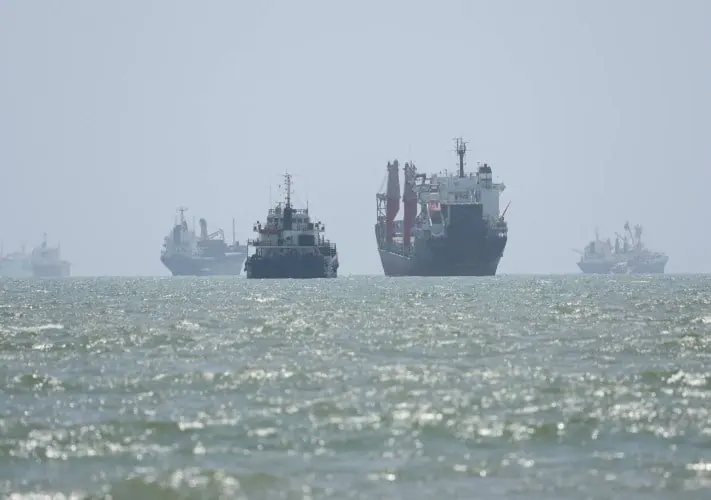
The UK's Maritime Trade Operations (UKMTO) center reported that at least two ships were attacked over the weekend in waters near Oman and Iran. On Saturday, the UKMTO received a report of a crude oil tanker being hit by an unknown projectile about four nautical miles east of Oman. The incident occurred as Iran continued to insist that the Strait of Hormuz, a critical waterway for global oil supplies, would not be reopened unless its demands were met.
On Sunday, the UKMTO reported another attack on a ship in the Strait of Hormuz, resulting in damage to its engine room. The incidents are part of a series of attacks on ships navigating the strait in recent weeks. The Strait of Hormuz was a key passage for about a fifth of global oil supplies before the US-led war against Iran began in February 2019. Iran's Parliament Speaker, Mohammad Bagher Ghalibaf, said on Sunday that the Strait of Hormuz would not be reopened unless Iran's seven demands, based on the Islamabad Memorandum, were met.
The demands include an end to US "aggressive actions", the lifting of the US naval blockade on Iranian ports and the economic war, and the release of Iran's frozen assets. In return, the US had demanded that Iran dismantle its nuclear weapons program. The tensions in the region have been escalating since the US and Iran agreed to an interim deal in June, known as the Islamabad Memorandum, which led to a temporary halt in fighting.
The attacks on ships in the Strait of Hormuz have contributed to rising energy prices in recent weeks, fueling inflation expectations and adding to upward pressure on government borrowing costs. The reports of the US planning to send a third strike group, centered around an aircraft carrier, to the Middle East, along with a 2,000-strong Marine Corps amphibious force, have also driven up crude oil prices.
On a separate note, reports emerged of new attacks on Saudi Arabia's energy infrastructure. The Yemeni Houthi group, allied with Iran, claimed to have targeted a facility belonging to Saudi Aramco in Riyadh using ballistic missiles and drones. The group said the attack was in response to Saudi attacks on the Yemeni capital, Sanaa, and other provinces.
The situation in the region remains volatile, with investors expecting a resumption of large-scale fighting. Some analysts believe that the question is not whether conflict will resume but when it will happen. The ongoing tensions have resulted in higher energy prices, and the global economy is bracing for potential further escalation.
The developments have led to an increase in oil prices, although they eased slightly on Friday after the G7 countries announced plans to release diesel and crude oil stocks to ease the burden on consumers. The price of Brent crude, the international benchmark, fell by 6 cents to $102.25 per barrel, while US West Texas Intermediate crude dropped by $1.76 to $91.11 per barrel.
Key points
- Iran's demands for the US to lift sanctions and end "aggressive actions" remain a major point of contention.
- The attacks on ships in the Strait of Hormuz have contributed to rising energy prices.
- The situation in the region remains volatile, with investors expecting a resumption of large-scale fighting.